
To define ensemble in music, Grove Online tell us that In instrumental music, German usage tends to restrict the term to light music for small groups or to the performing groups themselves. In English, applies loosely to any instrumental group, sometimes to orchestras (but not usually to the music played). In light of this, the history of woodwind ensembles could certainly be set toward primitive times. It is not hard to think of a duet of pre-historic man or woman blowing onto bone flutes, identical to those found in southwest Germany and Slovenia dating about 45,000 to 40,000 years ago. One may also suggest that in New Guinea, where there is a kind of primal bamboo flute called the man and the woman blown constantly in a synchronized manner for ritual purposes, it could also be considered a duet for a wind ensemble. Analogous to those earlier examples, can be seen plausible an ensemble of Ney (Egyptian flute), which are an example of the three- or four-holed open-ended flutes (Baines. 1957: 176) provided by ancient civilisations like Egypt, Sumeria and China. Baines tells us that primitives played the flutes, and later on, the ancients played reed musical instruments, the oriental, and we played both. He also tells us that at some point in the birth of civilisation, it must have progressed to the next phase of musical development, suggesting that the reed pipe was improved to become more of a musical instrument. At a time when the Greeks and Romans constructed their civilisation, some instruments that were considered fundamental, became relegated (Baine.1957:209) to folk instruments. Other instruments, such as the hornpipe, were left just for shepherds.
In the middle ages, during the 16th and 17th centuries, a group of players with the same family instrument was popular in England. It was called the consort (Britannica). From the research produced, it seems that before the formation of the standard woodwind quintet (established in around 1800) during the renaissance the woodwind ensemble could comprise any of the following instruments: Bagpipe, Bladder Pipe, Cornamuse, Crumhorn, Dulcien, Gemshorn, Hirstenschalmei, Kortholt, Lizard, Pipe (paired with the tabor), Rackett, Rauschpfeife, Recorder, Schalmei, Serpent, Shawm, Shofar, Transverse Flute, and Zink (Jesstone. 2020). Information found in Britannica encyclopaedia also seems to suggest that the consort of Crumhorns was an excellent ensemble.
Suppan adds that the cornetts and trombone blended nicely as a treble instrument or along the shawms in loud consort. The Renaissance recorder also blended well in consort. Due to the loudness, these instruments were used to perform tower music in central European cities. Edwards tells us in Grove Online that from 1575 to about 1700, the compositions of wind instruments like Hautbois and Recorders were suitable for the reception of people of high rank. Consort music was frequently performed in the theatre, and the use of Oboes had magical associations and was often referred to as evil threats. Furthermore, the soft sound of Flutes or Recorders sometimes symbolizes death. In the early 17th century, the Renaissance reeds that could not adapt to outdoor music disappeared, except for the Curtal. The Shawm survived slightly longer in the West and remained important in the East.
In the baroque, due to the expressiveness of the composition, the woodwind instruments that could not imitate the passions (Suppan) were relegated to the background or contrasting support for the melody. However, the woodwind instruments were altered to compete with the string section’s expressiveness. In the meantime, the winds were used for dance, church, palaces and municipal music. In the Classical period, two Flutes and a couple of Oboes were usually added to a small orchestra, whiles one or two Bassoons were added later, with Clarinets finding their way towards the end of the 18th century (Bennet.1987:38). Generally speaking, whether in the baroque the woodwinds had just harmonic and decorative implications, from the late Classic to early Romantic period onwards they began to take principal roles in the orchestra.
The standard woodwind quintet in a usual combination (Supang) is Flute, Oboe, Clarinet, Bassoon and Horn. The arrangement benefited from the technical enhancements made to wind instruments during this time. In today’s formal education, as an example found in the Anderson’s University of South Carolina, ensembles are Flute ensembles, including Piccolo Alto Flute, and Bass Flute in some cases. A Saxophone ensemble is a quartet of two Alto Saxophones and a Tenor and Baritone Saxophone. Clarinet ensemble of four or more, along with the typically B Flat Clarinet, sometimes using the E Flat Soprano Alto, Bass, and Contrabass Clarinet. Woodwind Quintet features a Flute, Oboe, Clarinet, Horn, and Bassoon. Also, it seems that the repertoire for every ensemble is different depending on the instrument’s characteristics. According to the named University, the Flute, Saxophone, and Clarinet ensembles perform ‘standard repertoire’ for their instruments. I have included a pdf with this repertoire. The woodwind quintet, however, includes classical, new and pop music.
From the picture below, one can observe the instruments’ different instrumentation and chronological changes.
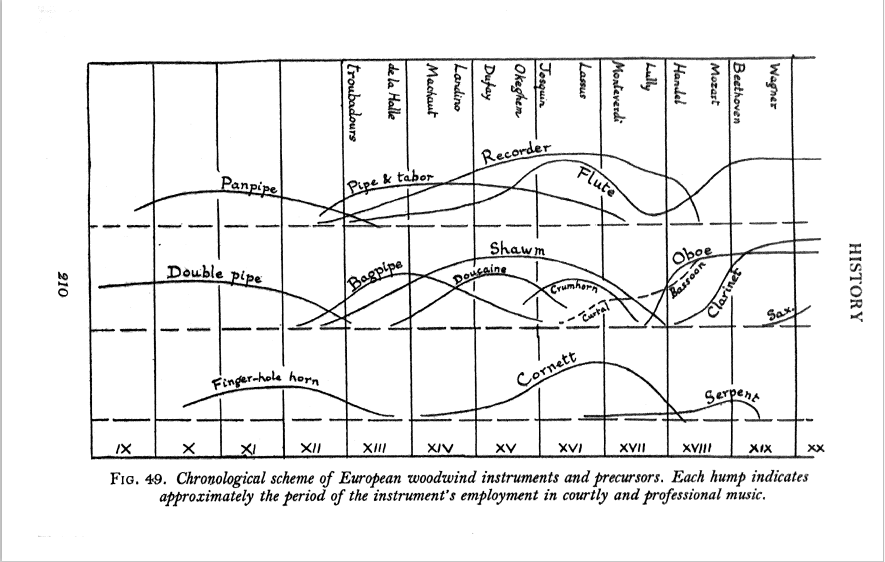
By analysing the graphic, it can be seen that the ancient Panpipe became what we today understand, and the Flute, the Double Pipe into the reed family, including the Oboe, Bassoon, and Clarinet and Fingerhole Horn could be the precursor of the Cornett in the 15th and 16th century. It seems reasonable to think that the Fingerhole Horn is the primitive instrument of what will become the brass instruments of today. Furthermore, the graphic can disclose the heavy use of the Flute in the XVI century and its decline around the 19th century, coinciding with the Oboe’s growth.
References
Anderson University. Woodwind Ensemble. Accessed on 22 Dec. 2022 from: https://andersonuniversity.edu/academics/school-of-the-arts/music/ensembles/woodwind-ensembles
Austin, Robert. 2021. Wind Instruments. Accessed on 22 Dec. 2022 from: https://www.britannica.com/art/wind-instrument/The-Renaissance
Baine, A. 1957. Woodwind Instruments and their History. W.W.Norton & Company Inc.
Bennett, R. 1987. Cambridge Assignments in Music. History of Music. Cambridge University Press.
Britannica, The Editors of Encyclopaedia. “consort”. Encyclopedia Britannica, 2016, https://www.britannica.com/art/consort-music. Accessed 17 December 2022.
Cook, Elisabeth. “Ensemble.” Grove Music Online. . Oxford University Press. Date of access 17 Dec. 2022, https://www.oxfordmusiconline.com/grovemusic/view/10.1093/gmo/9781561592630.001.0001/omo-9781561592630-e-0000008853
Edwards, Warwick. “Consort.” Grove Music Online. . Oxford University Press. Date of access 18 Dec. 2022, https://www.oxfordmusiconline.com/grovemusic/view/10.1093/gmo/9781561592630.001.0001/omo-9781561592630-e-0000006322
Griffiths, P. 2006. A Concise History of Western Music. Cambridge University Press.
Jestone0223. 2020. Reinssance. Accessed on 22 Dec. 2022 from: https://www.coursehero.com/file/56403179/Renaissance-SFHRMTX/
Suppan, Wolfgang. “Wind quintet.” Grove Music Online. . Oxford University Press. Date of access 17 Dec. 2022, https://www.oxfordmusiconline.com/grovemusic/view/10.1093/gmo/9781561592630.001.0001/omo-9781561592630-e-0000030404
Next: Exercise: Wind Ensembles
 Orchestration and Arrangement