
Jose Luis Uceta-Martin
Student number: 516695.
Module: Orchestration and arrangement https://drorchestrationandarrangement.music.blog
This essay aims to shed light on Jerry Goldsmith’s use of electronics and unconventional instrumentation in his orchestration. The composer’s orchestration is indicative of his approach to film score and his ability to mirror the film’s scenes enhancing the emotional effect with sounds. In addition, this essay briefly discusses the role of the orchestrator in his works.
Introduction
Jerry Goldsmith (1929-2004) was an American composer who made a remarkable contribution to the world of film music. He was born in Los Angeles, California and showed an early interest in music. He studied piano and composition from a young age (Goldsmith). After completing his education, and working as a typist in a radio station, Goldsmith began his career as a composer for television. He worked on various shows and earned a reputation due to his versatile and innovative approach. Jerry Goldsmith was pushing forward the boundaries of TV music (Corrigan). In the 1960s, Goldsmith shifted to film scoring, and it was during this period that he established himself as one of the most influential and respected composers in the industry. According to the above reference, his music encompassed 270 titles and a wide range of genres. His works include science fiction, action, adventure, horror, drama, and fantasy. This vast variety of genres is evidenced by films such as Alien (1979), Total Recall (1990), Chinatown (1974), The 13th Warrior (1999), The Mummy (1999), The Detective (1968) and Legend (1985).
Jerry Goldsmith’s Approach to Film Scoring and Orchestration
Goldsmith’s musical language and orchestration was unique and wide-ranging. He drew inspiration from various genres. The composer incorporated unconventional instrumentation, untried techniques, dissonant experimental harmonies, and memorable melodic motifs. Following his winning of the Academy Award, he began experimenting in the realm of electronics. We found evidence in his words during the late 1970s and 1980s. He also was not afraid to push boundaries and frequently incorporated avant-garde formats (Apple), such as atonal harmonies and unique percussion techniques, to create a distinct sound. According to Burlingame, the composer himself was always unwilling to delve into the details of his compositional methods. Goldsmith himself said, that to describe how one writes music is impossible, I can’t intellectually tell you how it gets from the head and the heart, through my arm, down to my hand and onto the paper.
At this point, it is worth stating that Goldsmith did not orchestrate all his works. Evidence is found on IMDb’s his short but concise mini biography. The editors of the website claim that the main man for this job was the orchestrator, Arthur Marton (1908-2000). Arthur Marton, born in Duluth, Minnesota, orchestrated almost every movie score composed by long-time friend Jerry Goldsmith. In the 50s he began a professional partnership and friendship that was to last over 30 years (Thomas). He also orchestrated George Duning (1908-2000) in the 40’s through the 60’s. Upon discovery of this new information, one could potentially feel the reputation given to Goldsmith’s orchestration reduced. Perhaps reflecting on the fact, that, he was not ‘orchestrating’ his compositions. However, it will appear that as early as Berlioz’s (1803-1869) meaningful Treatise on Orchestration and Instrumentation (1858), these two concepts, along with composition seem to be closely related. Furthermore, evidence that Goldsmith gave almost complete instructions on how he wanted the orchestration to be accomplished is found in Paul Andrew McLean’s article on Film Score Monthly.
He tells us that a composer like Jerry Goldsmith sketches his cues, every creative detail is provided in these sketches – instrumental groupings, dynamics, and indications for all the notes. It is just written in a kind of compressed shorthand, perhaps with some occasional verbal instructions. Further evidence is found in Arthur’s own words. He once said that his job in orchestrating for Jerry Goldsmith was certainly very straightforward. I take the music from the yellow paper and put it on the white paper. Indicative that he was receiving almost the entire composition, orchestration, and instrumentation previously set and ready. We can then agree that Arthur’s work was to write back idiomatically and expand the short score provided by Jerry Goldsmith.
Analysis of Goldsmith’s use of electronic elements in his orchestration
Jerry Goldsmith was unafraid to use a wide variety of electronic sounds and instruments, which are now available, in such critical successes as Star Trek: The Motion Picture (1979), Under Fire (1983), and Hoosiers (1986). Goldsmith utilised the best of synthesised accompaniment, often performed live as a fifth section of the orchestra. According to Bushman, Goldsmith also has utilised church organs and even a custom-made instrument called Blaster Beam, refined, and made by Craigh Huxley. During the listening of the track Main Title and Klingon Battle, in minute 03:31 the composer utilised an unexpected and electronic sound. This sound, which could be substituting the sound of the gong as it is accenting and announcing a modulation, could potentially be the instrument sampled and edited. Further in the work, at about minute 03:49 other electronic sounds, this time synthesised strings, seemed to be added to create an extra layer of tension or to add tonal weight. Jerry Goldsmith also used an electric guitar sound at minute 04:00. In addition, the synthesised phasers seem to be also present in the track. Although in the film Under Fire, the use of electronics is more sparingly, there exist elements of synthesized sounds. A flute sampled and edited appears to be added in track 3 House of Hammocks. His soundtrack for the film Hoosiers is evidence of both electronic and unconventional orchestration. Goldsmith uses synthesisers and full drum kits along with the traditional orchestra. A further example of Goldsmith’s involvement with electronics and orchestra is evident in his soundtrack Total Recall (1990). The film is described by Filmtracks.com, as a blockbuster of low moral character and extraordinary special effects. According to the same source, the film was critically embraced having the correct director, actors, story, and composer, thus creating an enormously entertaining result. Goldsmith used electronic sounds to shape the overall sound design. In this manner, he created an interesting and enhanced atmosphere for the score. In this work, he also used synthesisers to add extra electronic layers and texture to achieve a hi-tech and futuristic at times mood. These additions produced a sense of mystery and tension as evidenced in the main theme The Dream.
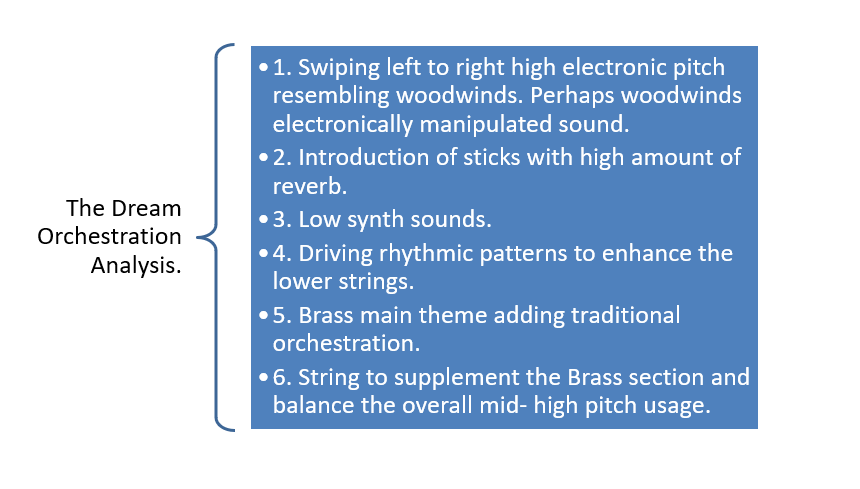
The graphic on the left shows how the electronic elements were often used to provide rhythmic drive and to create unique textural effects. Jerry Goldsmith appears to be exploiting electronic percussion and synthesised rhythms to boost the intensity and energy in his orchestration. By using a low filter processing, he could also intensify the sense of drama on the score.
Analysis of Goldsmith’s use of unconventional instrumentation
Jerry Goldsmith did not only use electronics in his orchestration to create diversity and enhanced sounds. His orchestration also used unconventional instrumentation to deliver different timbral textures. Goldsmith creates a mixture of ensembles, using traditional and non-traditional instruments to create these textures. Evidence of his unusual ensembles is found in the score of the film Chinatown (1974). Robert Evans, the producer of the film, said that Goldsmith composed the music in ten days. The instrumentation used was only pianos, four harps, strings, two percussions and a trumpet (Lysy). But perhaps the most striking and bizarre example of orchestration and extended techniques used in a score for a film, in addition to Alien (1979), is found in his composition for the film Planet of the Apes (1968). The film is based on a book by Pierre Boulle and follows the lives of a group of astronauts who crash on a faraway planet. This planet is ruled by civilised apes. The movie is both thrilling and thought-provoking, dealing with issues such as evolution and humans’ place in the universe (Pfeiffer). Goldsmith adapts these provoking ideas and presents them into music through his orchestration and instrumentation, perhaps in proportion to Stravinsky’s (1882-1971) The Rite of Spring. (1913). Burlingame tells us that his approach to composition was to create an impressionistic, otherworldly soundscape using only non-electronic instruments. Some of these are experimental and unfamiliar sounds including horns blown lacking the mouthpieces and a bass clarinettist fingering the notes without actually blowing into it. Other instrumentation used are ram and Tibetan Horns, boo-bams, electric bass clarinet and vibraslap (Pearsons). According to Fitzgerald and Hayward, in the score also exist dissonant ideas created by sliding two string notes on the same pitch and then sliding one part up to create a semitone clash.
Conclusion
Jerry Goldsmith’s orchestration style was evidence of his creativity and versatility to adapt to any film genre without always defaulting to follow traditional orchestration. By using electronics and unconventional instrumentation, he intensified and augmented the power of the orchestra, and expanded the sonic possibilities of film scoring.
Through his orchestration, he produced expressive textures applying a wide range of extended techniques and experimenting with electronic sounds. By pushing these boundaries and adapting to new and evolving technology, he led the film composition scene, making an impressive career and an extraordinary legacy. Jerry Goldsmith’s orchestration style has served as an inspiration to composers and musicians alike, demonstrating the power of merging both electronics and traditional orchestras. Jerry Goldsmith lived in the era of experimenting with sound, extended techniques, and electronics. These Stylistic characteristics are well imprinted on the orchestration and works of Edgard Varese’s (1883-1965) Ameriques (1921) and Stockhausen’s (1928-2007) Sirius (1980). However, Goldsmith’s scores also had Classical elements. These elements are evident in his best music original score (IMDb) Award Winning score The Omen (1976). In this particular score, Goldsmith blended Classical instruments with a demonic eery Choir in a SATB traditional format. The composer also used extended techniques employed by classical composers such as Krzysztof Penderecki (Fitzgerald and Hayward).
Goldsmith’s hallmark became his Classical development and structure with epic styles (Buchmann) as evidenced in his later scores The Mummy and The 13th Warrior among others. His legacy of orchestrating with electronics and his epic style remain to this day. One can easily perceive similarities between his music with space theme games like Eve Online experience. In the trailer, one can sense a trail of Goldsmith orchestration and music from the film Total Recall.
How has this research and the module helped identify my orchestration?
Researching a composer’s orchestration techniques has been valuable and enlightening. It has offered a deeper understanding of the art of orchestration and has significantly enhanced further skills. Furthermore, it is also beneficial as it provides a historical perspective on how the orchestration techniques have evolved and what techniques remain the same. Also, has been tough how the instrumentation has changed, what has remained and what impact has generated on older and newer generations. Each composer has a unique style and approach to orchestration. By analysing his works, it helped to understand the choices and preferences, such as instrumentation, their combinations, timbres, and textures. This can be inspiring to future compositions and help the development of one own voice or style. The composers pushed the boundaries of the instruments to achieve the desired sound. Researching his works and orchestration, and by studying his works, has exposed the insight of how the instruments can be pushed to limits. Furthermore, how the performers manage to achieve the sounds. It is important also to note how composers write idiomatically for the instrument and what that means in our works. The orchestral colours of the composer are also different and varied. By studying these elements, one can learn how emotions and colours are related and what colours the composer practises to achieve the emotions desired. In conclusion, researching a composer’s orchestration can be an invaluable source of knowledge and inspiration for orchestrators and composers. It offers insights into historical and stylistic aspects, instrument capabilities, and problem-solving strategies. Studying the orchestration choices of the masters, can expand the orchestration toolbox and develop a deeper appreciation for the art of orchestration, ultimately enhancing the ability to create expressive and convincing traditional or unconventional orchestral music.
(2000 Words)
References:
Apple. 2023. Jerry Goldsmith. Accessed on 07/11/2023 from: https://music.apple.com/ca/artist/jerry-goldsmith/504767
Arleigh. 20th October 2014. Horror song of the day. Ave Satani by Jerry Goldsmith. Accessed on 19/05/2023 from: https://unobtainium13.com/2014/10/20/horror-song-of-the-day-ave-satani-by-jerry-goldsmith/
Brooks, Vincent, ed. (2006). You Should See Yourself: Jewish Identity in Postmodern American Culture. Rutgers University Press. p. 96. ISBN 9780813538457.
Burlingame, J. 2nd August 2004. Jerry Goldsmith: An appreciation. Film Music Society. Accessed on 15th May 2023 from: http://www.filmmusicsociety.org/news_events/features/2004/080204.html
Bushmann, C. June 2015. The Musical conventions of Star Trek. A Search for Syntax in Science Fiction. https://www.academia.edu/13616260/The_Musical_Conventions_of_Star_Trek_A_Search_for_Musical_Syntax_in_Science_Fiction
Bryce, A. 1981. A conversation with Jerry Goldsmith. Soundtrack Magazine N.2. Accessed on 12/07/2023 from: https://archive.ph/20130217113426/http://www.runmovies.eu/index.php?option=com_content&view=article&id=68:a-conversation-with-jerry-goldsmith
Corrigan, P.J. Mini Biography Jerry Goldsmith. IMDb. Accessed on 15th May 2023 from: https://www.imdb.com/name/nm0000025/?ref_=nv_sr_srsg_0_tt_2_nm_6_q_jerry%2520gol
Gassi, V. May 2019. The forbidden Zone, escaping earth and Tonality. An Examination of Jerry Goldsmith’s Twelve-Tone Score for Planet of the Apes. Accessed on 07/11/2023.
Goldsmith, Carrie. Preview of The Aborted Jerry Goldsmith Biography. Retrieved March 15 May 2023.
Fitzgerald, Jon, and Philip Hayward. “The sound of an upside-down world: Jerry Goldsmith’s landmark score for Planet of the Apes (1968).” Music and the Moving Image, vol. 6, no. 2, summer 2013, pp. 32+. Gale Academic OneFile, link.gale.com/apps/doc/A458602660/AONE?u=ucca&sid=summon&xid=1fccba91. Accessed 6 Nov. 2023.
John. 12th February 2018. Alien an analysis. Kecas Film. Accessed on 25/06/2023 from: https://kecasfilm.blogspot.com/2012/07/alien-1979-film-analysis.html+
Lysy, C. 26th March 2018. Chinatown – Jerry Goldsmith. Accessed on 10/11/2023 from: https://moviemusicuk.us/2018/03/26/chinatown-jerry-goldsmith-2/
MacLean, P. 21st September 1997. What Orchestrators Do. Accessed on 26/10/2023 from: https://www.filmscoremonthly.com/daily/article.cfm/articleID/2299/What-Orchestrators-Do/
Marks, M. (2020, March 30). Goldsmith, Jerry. Grove Music Online. Retrieved 6 Nov. 2023, from https://www.oxfordmusiconline.com/grovemusic/view/10.1093/gmo/9781561592630.001.0001/omo-9781561592630-e-3000000188.
Music Notes. Ave Satani Score. Accessed on 19/05/2023 from: https://www.musicnotes.com/sheetmusic/mtd.asp?ppn=MN0077740
Pearson. The hunt. Further Musical Understanding. Accessed on 15/08/2023 from: https://qualifications.pearson.com/content/dam/pdf/A%20Level/Music/2013/Teaching%20and%20learning%20materials/Unit%206%20-%2044.%20Jerry%20Goldsmith.pdf
Pfeiffer, Lee. Planet of the Apes. Encyclopedia Britannica, 19 May. 2023, https://www.britannica.com/topic/Planet-of-the-Apes-film-1968. Accessed 10 November 2023.
Reba, W. (2013). The Scores of Jerry Goldsmith. In A Dimension of Sound: Music in The Twilight Zone (Music and Media, pp. 69-86). Boydell & Brewer. doi:10.1017/9781576473252.006
Shrobis, C. 01July 2017. All films composed by Jerry Goldsmith. IMDb. Accessed on 15th May 2023 from: https://www.imdb.com/list/ls0 68625775/
The editors. Arthur Morton Biography. IMDb. Accessed on 26/10/2023 from: https://www.imdb.com/name/nm0607925/bio/?ref_=nm_ov_bio_sm
Thomas, A. 2008. Spotlight Arthur Morton. Accessed on 26th October from: http://www.jerrygoldsmithonline.com/spotlight_arthur_morton.htm
 Orchestration and Arrangement