
Iamus Computer (N/A) – Hello World! (2011) 15th October 2011, Keroxen Music Festival, Santa Cruz de Tenerife, Spain. Accessed on 28/02/2023 from: https://youtu.be/bD7l4Kg1Rt8
This piece of music is claimed to be the first complete composition generated by a computer without human intervention. The software has been created so that the piece is idiomatic and grammatically correct. However, I felt that a post-tonal system like serialism has been employed. The piece is composed of piano, violin, and clarinet. Although the piece can be grammatically correct and written idiomatically for the instruments, I feel it lacks the human interpretation of feelings and emotions. The music appears monotone and without purpose, unlike other serial compositions like Schoenberg’s trio for strings op.45. The composition has all the elements to create a musical artwork without any recognised tonal progression. There is a great balance of tone, dynamics, and usage of instruments. I feel that the software could be reprogrammed to contain atonal and tonal choices, perhaps emerging a little clearer to avoid monotony. Overall, the experience has been amusing. However, due to the lack of fundamental human resources, it has been given a robotic aura. Maybe it’s the way forward from 21st-century music and beyond.
William Grant Still (1895-1978) Afro-American Symphony no. 1 (1930). Detroit Symphony Orchestra. Accessed on 28/02/2023 from: https://youtu.be/x4wVSdzWd-M
This work was found after researching diversity in music composers. Brittanica claim that Still was the first African American to conduct a professional symphony orchestra in the United States. Though a prolific composer of operas, ballets, symphonies, and other works, Brittanica claims this is his best-known composition. I could appreciate a wide diversity of effects within the composition, like muted trumpets, usually in imitation counterpoint with the horns. Other effects noticed were the descending chromatic runs along with glissandos in the string section. The inventive and unexpected application of the percussion was also noticed, along with the harp’s extensive use and the Bassoon’s principal role at times. The composer’s predilection in the first part of the work seems to be to use woodwinds for the melody, relegating the strings and brass for decorative purposes. In terms of instrumentation, the composer appeared to merge the sounds of Clarinets and flutes in the mid-registers, producing a smooth transition between instruments. The composer also exploits the sounds of Bassoons and Clarinets, producing a dense and dark sound. By choosing a limited amount of instruments that perform at a time, he delivered a balanced texture making the overall sound very clean and clear. At some point in the symphony, a little essence of Antonin Dvorak’s (1841-1904) Symphony n.9 (1893), perhaps due to the traditional American folk rhythms applied to both compositions. Although Still’s approach to melodic and rhythmic structures seems more in line with Blues and Jazz. It seems that Still also interpolates well-defined blues and classical-styled sections throughout the composition. Overall the composition seems well-balanced in tone, textures, instrumentation, variety and extended use of some instruments that normally are applied for embellishments or accenting phrases.
Sophia Dussek (1775-1831) – Sonata for the harp in Cb l op.3 n.3 (1797). Accessed on 28/02/2023 from: https://youtu.be/EIawTZtSTBM
This piece of music was found on youtube when searching for female composers. A small research on the internet shed light on the composer. However, when I downloaded the score from IMSLP, the composition seemed credited to another composer, Jan Ladislav Dussek (1761-1812). One can only suspect that the composition was made by J.L. Dussek and performed by Sophia, her wife. Besides these rather anecdotal facts, the sonata seems to be produced in 3 movements. The main theme is very lively and cheerful. There seems to be a lot of note repetition, especially in the form of pedal notes, emerging to my mind the extensive use of pedal notes in some works of Beethoven, like Symphony 6. The composition also benefits from octaves, which bring a delectable quality to the section where it is used. The composition itself is quite elegant in form, reminding me of the court or dance music of the era, as per the sense and devices applied, like sequences, counterpoint and colourful suspended cadences. Other stylistic characteristics of the piece are noticeable, like the accompaniment of pedal notes or ‘trommmelbasse’ and the clarity and straightforwardness of some passages. In minute 5:19 of the performance, the harp sounded just like a guitar, which was quite amusing. There seems to be a composition based on melody and arpeggiated harmony. It seems well balanced in tonality with major-minor variety as per the sonata form. It is quite a delightful piece due to the characteristics mentioned, and also it has a good potential for a future Piano arrangement of the work.
Richard Strauss (1864-1949) Till Eulenspiegel’s Merry Pranks (1894). Symphonieorchester des Bayerischen Rundfuck. Accessed on 28/02/2023 from: https://youtu.be/QV5r9KG1eyc
This composition by Richard Strauss is what seems like an excellent source of analysis and planning for my own compositions. Resembling film music, the overall work is very amusing lively and enjoyable due to the variety of thematic material and motifs passing from one section to another of the orchestra. From the listening, it can be seen the Clarinets are not in unison, just like my tutor advised, so they do not run into intonation problems.
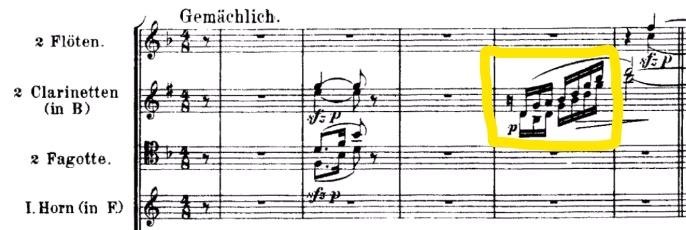
That said, I have encountered some passages or motifs where two oboes are in unison, proving the rich variety of the instrumentation from Strauss.
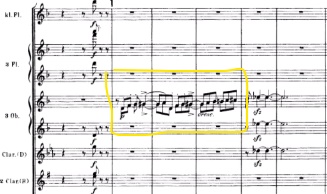
The work has some modern quality, like in section 14, where the Hons and Trumpets sound like George Gershwin’s themes, very contemporary and Jazzy. See the example below.
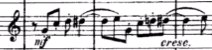
There was one device explained by my tutor regarding the application of dynamic and texture in some extreme cases. Below there is an example of ff tutti to p solo instrument.
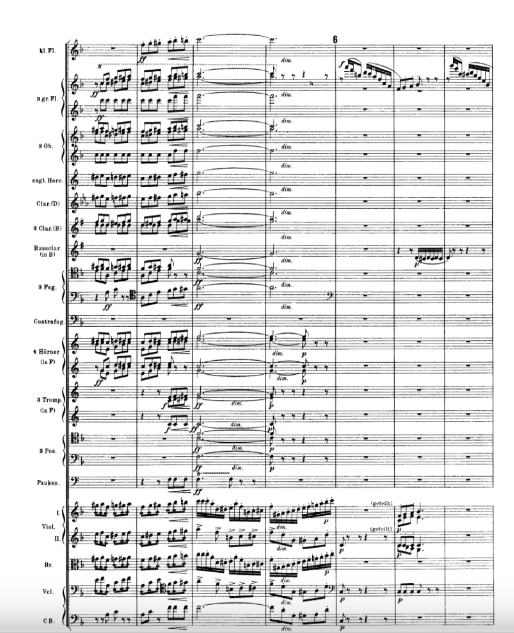
On page 33, the percussion section, most relevantly, the timpani reminded me of The Planets (1917) by Holtz (1874-1934) in the application of rhythms. There was a section that grabbed my attention at minute 4:00. The instrumentation applied by Strauss was 2 Horns, 3 Bassonss, 1 Bass Clarinet and 2 Clarinets. The sound produced was very calming and dense.
Beethoven (1770-1827) – Symphony n.7 in A major, Op.92 (1812). Berlin Philarmonic 1977. Accessed on 07 March 2023 from: https://youtu.be/JMrm9jEo_Pk.
Beethoven’s Symphony n.7 begins with a woodwind-centred melody. The composition seems to be based on repetitive cells and motifs applied within the rules of tonality. The work combines very quiet passages with very loud and powerful moments. This power that Beethoven seems to apply to the symphony is due to the crescendos and the power of all instruments playing simultaneously in fortissimo. There is a considerable balance of textures, from very light and solo instruments to heavy textures. bb 242-246 are a good example of heavy texture. These extremes and abrupt contrasts in power, dynamics and textures seem to be the composer’s signature. The percussion section adds intensity to work and helps create a powerful output. The instrument usage in some sections and statements is based on imitation counterpoint and sequences. There’s an example of syncopation in b.171. The composer seems to balance the use of instrumentation in every section. I also noticed a section where the only instrument assigned with the melody was the 1st violin. All other instruments were either supported harmonically or as decoration. I felt the orchestra’s power was wrapping the melody so it could not be heard properly. Perhaps is the composer’s intention. However, I feel it could have benefits for the addition of second violins in octaves or unison. In the second movement, the conjunction of the cello and viola in unison performing the melody was felt to be quite interesting and moving. Also, I noticed the clarinets in octaves, perhaps to widen or thicken the orchestra sound. I feel the orchestration of this work can serve as a stepping stone towards my understanding of general practice and techniques.
Anna Clyne (1980-Present) – Masquerade (2013). Performed by BBC Symphony Orchestra. Avie Records. Accessed on 12/03/2023 from: https://youtu.be/wEOchchAuWk
This work by composer Anna Clyne strongly resembles film music by various composers, including the soundtrack by James Horner (1953-2015), The Mask of Zorro (1998) and Stargate (1994) by David Arnold (1962-Present). The work seems to portray six or seven scenes in which the material appears to interwave in a variation-like method. This form of composition was encountered before in work Le Onde (1996) by Ludovico Einaudi (1955-Present). There are plenty of emotions in work. However, due to the shortest of the sections, there seems to be no continuity in the thematic material. The coherence seems to be found in the repetition of some themes and recognisable sections. Although not completely atonal, the work appears to lack a tonal structure in a strict home-away from home-home environment. There exist instances of syncopated rhythms marked and accented by the percussion section. Something that caught my attention was the descriptions of the sections. Some of these descriptions seem to follow specific instrumentation. Examples are soaring with grandeur, in which all instruments seem to perform long notes. Lilting but ominous, in which the strings and woodwind sections seem to have the principal role. And vigorous and thorny, in which the accented dynamics with fast semiquavers are performed by strings, horns and woodwinds. The work ends with a big crescendo. The piece feels fresh and entertaining as a mix of soundtracks and short scenes, also approaching various old styles of music like folk. The work is envigorating and powerful at times.
Florent Schmitt (1870-1958) Legende for Alto Saxophone and Orchestra (1918). University of Southern California Thornton Symphony. Accessed on 12/03/2023 from: https://youtu.be/MHJmHAPFrnQ
The first characteristic that stood out in this composition from Florent Schmitt is how similar it was in style if compared to The Planets (1917) by Holtz (1874-1934). What it seems that vast amounts of works contemporary of Holtz and after his time are comparable. Although it is true that a masterpiece and a grandiose work like Holtz’s The Planets is difficult to surpass, Legende for Alto Saxophone and Orchestra has devices and characteristics to become a stepping stone in composition and analysis. The use of instrumentation appears to be disjoint. Rather than utilising many instruments to perform together, Florent seems to apply one instrument at a time. There appears to be not much repetition in the work. The coherence appears to be in the balance of the orchestra’s timbre. Like what I considered the ‘psychedelia in classical music’, this work does not seem to follow any chordal or tonal hierarchy. However, employs chromatic, and non-chromatic scales, in addition to grammatical devices like chords, to support coherence. The sense of the piece is rather obscure and enigmatic, perhaps taking the listener to the insides and dark side of the composer. By choosing an Alto Saxophone, the composer tries to exploit the obscurity and darkness of the instrument and, at the same time, take advantage of his trumpet-like sound in the high registers. I noticed in b. 3 a divisi mark on strings and octave divisi in the violins further in the work. The cello and double bass were also noticed to be written in octaves in some passages, and the Horns in thirds. It was also noticed that the Brass section was applied when seeking to produce excitement between sections. The more I listen to the piece, the more I seem to comprehend the content and purpose of the devices produced by the composer. It has been a great experience, and I will consider this work for content, device application and analysis for future works.
Vangelis (1963-2022) — 1492 Conquest of Paradise (1992). Orquesta y Coro de “Voces para la Paz” 2013. Accessed on 12/03/2023 from: https://youtu.be/lZSxDoizLfU
This is an arrangement for Orchestra and a Choir of the theme for the film Conquest of Paradise by Vangelis. Due to the nature of the arrangement, most of the emphasis has been directed to the voices. On the contrary, other arrangements made, like the one by John Williams for instance, focus on instruments rather than choir. The theme is assigned to the Brass in first instance. Link here. John Williams’ arrangement also lacks the power of ‘voces para la paz’, due to the vast size of the choir of the second. The original soundtrack employs samples of renaissance instruments, perhaps it would have been appropriate to perform with similar instruments, althght it seems that the percussion it does in fact employ a drum from the era. The percussion appears to act as a continuo playing. There seem to be few more phrases added to this arrangement that do not exist in the original. Two sections, at the begining and at the end was noticed. Additional notes were added and the end extended for a few bars. This is one of my favorite themes, an extraordinary lifting and motivational score that brings lots of memories. I had in mind to produce an arrangement of this particular soundtrack and I feel more motivated after finishing this part of the module thanks to the knowledge adquire and the listening.
 Orchestration and Arrangement