
Listening part 1
Errol Lynwallen (1958-Present) – This Frame is Part of the Painting for mezzo-soprano and orchestra (2019). August 15th 2019, BBC National Orchestra of Wales, Royal Albert Hall. Accessed on 20th September 2022 from: http://www.errollynwallen.com/play/orchestral/this_frame_is_part_of_the_painting
In this composition by Errol, the main principle of orchestration seems to be blending the available colours of the orchestra through the instruments and their characteristic roles. However, the composer also applies extended techniques and clusters. I felt the piece was tonal because she preserves the tonic starting point in phrases. However, these phrases are atonal in construction and mainly clusters. These chaotic rhythmic patterns, several of which prompt some moments of Stravinsky’s The Rite of Spring, seemed to be constructed upon gestures and cell-like events rather than melody-harmony structure. It is due to those cells and patterns in different pitches and gestures that the composer presents these varieties of colour palettes unusual in the standard performance technique. Adding the mezzo soprano’s vowels adds another layer of colour and timber to the piece. After that, the mezzo soprano’s role was to sing words, which reminded me of the history telling of musicals and operas. One feature that stands out is the use of silence, which adds to the overload of key changes and instability in the gestures and melodic patterns; it made my mind wonder and felt a little uninteresting towards the end due to the lack of perceptible direction.
Aaron Copland (1900-1990) – Appalachian Spring, full ballet for orchestra (1944). Detroit Symphony Orchestra. Accessed on 25th September 2022 from: https://youtu.be/_RADEhJpTN4
Copland begins his ballet with a dron-like device performed by the strings in what strongly resembles The Ring Cycle by Richard Wagner. The main theme or phrases seems to be distributed to diverse instruments within the brass and woodwind section. There is a bold sense of polyphonic composition. Contrary to many other composers like David Arnold, Copland seems to apply percussion to add brightness, definition and detail to the music. Arnold, on the contrary, applies the brightness of the brass section to this matter. I have also noticed that the brass section, when convergences with the percussion section, music seems to hold additional punch. To add extreme power to the composition, Copland uses the whole orchestra in tutti and fortissimo dynamics. To present cheerful and giocoso moments, the composer seems to use bassoons and clarinets synchronised and in counterpoint. The flutes and the woodwind section, in general terms, seem to be employed to add colour to the harmony. Pizzicato on the strings and staccato in the woodwinds or brass is a suitable combination to add interest in phrases. There is a particular passage in bb.100-104 where the music strongly resembles the movement of Jupiter by Holtz. In terms of time signature, Copland seems to apply plenty of variable meter, mainly due to the composition being commissioned as a ballet.
Shulamit Ran (1949-Present) – Lyre of Orpheus (2008). Performed on August 6 at Perlman Music Program, Shelter Island, New York. Accessed on 01st October 2022 from: https://youtu.be/x71HACsogG0
Ran in this piece presents a composition that seems to be atonal in the structure; however, containing melodic lines in a tonal polyphonic construction. The composition relies mostly on phrases, which are constructed with big leaps between notes, and it appears that the phrases end with all instruments playing in some sort of atonal harmony. It could be that the fewer non-consonant notes are mingled with more consonant notes in a dance to create these unconventional and unusual sensations if we look at music from a tonal perspective. Broadly speaking, all individual instruments seem to have a life to themselves, often in what can be expressed as a sonic counterpoint in a string quartet fashion. The techniques observed are pizzicato, sforzando, con sordino, tremolo, double stops and other extended techniques like harmonics. Ran seems to balance the slow and fast passages between phrases and also the amount of low and high pitches. The composer also balances the use of the instruments chosen, so they almost have the same priority, although the cello takes the primary role at some points of the performance. Although I’m not so inclined to this form of composition, I enjoyed the piece for a while, as it reminded me of Schoenberg’s Pierrot lunaire. It seems that this work could be suitable for incidental music.
David Arnold (1962) – Independence Day (1996). Prague film orchestra. Congress Centre Prague on 21st of May 2016. Accessed on 07th October 2022 from: https://youtu.be/nfZ3HCGRGeE
David Arnold in this suite for the blockbuster independence day beggings with a strident almost all tutti loud and powerful intro with the melody apply to the brass section in all Marcia style. The composer’s form of composition resembles John Barry’s style, long, sweet and memorable melodies accompanied by a warm and soft harmony. Arnold applies the melody to brasses and strings mainly, creating an imitative counterpoint between sections. The woodwinds, rather than colouring or providing warmth to the piece, are primarily used to add high-pitched runs, which seems to be the composer’s signature as heard on the soundtrack Stargate (1996). Another characteristic of David Arnold seems to be to compose adding extreme textures, not leaving much space for silence at such, as all instruments within the orchestra seem to be active most of the time. The most powerful sections of the suite seem to be achieved by a tutti orchestra and fortissimo hits on the bass drums, kettle drums and snares. Adding military-sounding snare rhythms supported by the piccolo produces the army march needed for such a film. David Arnold also uses celesta, Glocks and triangles to add excitement, accenting and detail to phrases and the choir to build on an extra layer of sensitivity and warmth to the composition. I regard David Arnold highly, so one of my projects is to explore and analyse his in more detail his scores for a better understanding.
Ralph Vaughan Williams (1872-1958) – The Lark Ascending (1914). Performed by Hilary Hahn in the George Enescu Festival on the 1st of May 2017. Accessed on 15th October 2022 from: https://youtu.be/IOWN5fQnzGk
For this listening, I followed the score, and I had a greater experience rather than if I had just listened or watched the performance. There is no doubt that the violin has the principal role in the piece, which in its characteristics, perhaps reminded me of a concert for violin. The violin seems to have little imitative counterpoint with the flutes, horns, and clarinets. Those instruments are applied, generally speaking, as a harmony layer. These layers prepare an exquisite red velvet carpet, warm in almost all sections with woodwinds in a pianissimo dynamic. The melodies seem to be performed with double stops at times; they are sweet and calm melodies. The music appears to be very English, as per the use of thirds, which evokes the search for national identity in the music of the era when this piece was created. The double bass application seems to be on the low range, so the music acquires this grounding state and powerful enveloping character. The instrumentation is well distributed to balance the use of all instruments and simultaneously portrays the violin’s primacy. The first few chords have been transcribed for piano in an attempt at first analysis, and the harmony seems to be revolutionary for the time. Could Debussy have any influence on Vaughan Williams’s composition, or perhaps the evolution of music paid a part in Vaughan’s exquisite signature? Maybe this would be a good question for further research.
Jjos (-) Island Memories (2019). Island Memories, Contraseña Records SL. Accessed on 20th October 2022 from: https://youtu.be/hIcgb3ehn4Q
This is a relaxing piece of music in the style of chill-out music. The composition is not complex whatsoever, compromising 2 contrasting melodies against a crescendo steady harmonic slow pace. It seems to have been composed in the key of A minor, and the melodies seem to be in sequence, a stylistic characteristic of the baroque period. This fact proves how some methods of composition and characteristics, even so far in history, have endured and the firm implication of old music in our present times. It will also appear that chill-out music is a bifurcation of the minimalistic style of the 20th century due to the simplicity of the design. The form appears to be ABA, a first section where the melody and the counterpoint of it are introduced with no drumming until mid of the A section. The same pattern seems to be present in the B section, the non-drumming half section and repeated device in the second A section. Chill-out music, thanks to the heavy repetition and relatively consonant and straightforward melodic lines and rhythmic devices, appear to have a strong connection with religious, shamanic or tribal music, as all produce what seems to be entering into another dimension using the same methods, however, applied to different instruments. I must admit that I became involved in a similar project a few years ago link here.
John Williams (1932-Present) – Superman (1985). Warner Bros Publishing. Accessed on 25th October 2022 from cd.
John Williams’s soundtrack for the film Superman appears to be in the form of a march with a parade-style mid-section. Similar to David Arnold’s Independence Day, the assignment of melodies and harmonic context relies heavily on flashy, bold brass passages and tutti orchestral power. To balance the colour and sound of the orchestra, Williams also applies the melodies to the cellos, whether the woodwinds and brass are chosen for the harmony. The percussion assists the power of the orchestra with hits and rolls. To add detail and excitement, the composer seems to assign the harps and violins to perform runs. Doing a little mental analysis, it appears that the brass section provides bright sounds, power, and clarity. The string section is warm, employing cello and basses as grounds for the harmony. The woodwinds in this piece appears to sound particularly wooden, except perhaps in high pitches where they almost replicate the metal sounds.
Adam Khachaturian (1903-1978) Adagio of Spartacus and Phrygia (1988). The University of North Carolina Symphony Orchestra, Hill Hall Auditorium at UNC-Chapel Hill 27th April 2013. Accessed on 30th October 2022 from: https://youtu.be/f6ETMtbcKrc
In this adagio, Adam Khachaturian evidences the importance of the string section and its primordial role in the orchestra. The instrumentation is distributed evenly, although the strings and solo instruments from the other sections are given a prime role. Three main devices stand out from the piece, the repetitive cell from the beginning, the arpeggiated cello melody connecting section and the passing of the material from instrument to instrument almost with the same timber and pitch. The first clear transition is from cello to oboe, whiles the flute is colouring with short cells. The flutes passing the melody to violins and then to the oboe are also appreciated in the composition. The brass usage seems to layer colour to the harmony and distribute the colour in counterpoint with woodwinds and strings, except with the occasional roman-like funfair in the midsection. Also, regarding the brass and, in particular, the trumpets, the application was similar to that of David Arnold’s composition and not strangely enough in the masterpiece The Planets by Holtz. One device worth mentioning is the violin’s timber merging in an expressive counterpoint with the clarinets. Also, this adagio reminded me of the use of the strings section in the Adagio for strings by Barber. The percussion section adds intensity, power and excitement to the crescendos. One particular issue noticed was the brass barely emerging from the rest of the orchestra, which could be due to the reverberance of the hall not being taken into consideration when planning the performance. I feel that this suite could be perfect for transposing for piano.
Listening part 2
Iamus Computer (N/A) – Hello World! (2011) 15th October 2011, Keroxen Music Festival, Santa Cruz de Tenerife, Spain. Accessed on 28/02/2023 from: https://youtu.be/bD7l4Kg1Rt8
This piece of music is claimed to be the first complete composition generated by a computer without human intervention. The software has been created so that the piece is idiomatic and grammatically correct. However, I felt that a post-tonal system like serialism has been employed. The piece is composed of piano, violin, and clarinet. Although the piece can be grammatically correct and written idiomatically for the instruments, I feel it lacks the human interpretation of feelings and emotions. The music appears monotone and without purpose, unlike other serial compositions like Schoenberg’s trio for strings op.45. The composition has all the elements to create a musical artwork without any recognised tonal progression. There is a great balance of tone, dynamics, and usage of instruments. I feel that the software could be reprogrammed to contain atonal and tonal choices, perhaps emerging a little clearer to avoid monotony. Overall, the experience has been amusing. However, due to the lack of fundamental human resources, it has been given a robotic aura. Maybe it’s the way forward from 21st-century music and beyond.
William Grant Still (1895-1978) Afro-American Symphony no. 1 (1930). Detroit Symphony Orchestra. Accessed on 28/02/2023 from: https://youtu.be/x4wVSdzWd-M
This work was found after researching diversity in music composers. Brittanica claims that Still was the first African American to conduct a professional symphony orchestra in the United States. Though a prolific composer of operas, ballets, symphonies, and other works, Brittanica claims this is his best-known composition. I could appreciate a wide diversity of effects within the composition, like muted trumpets, usually in imitation counterpoint with the horns. Other effects noticed were the descending chromatic runs along with glissandos in the string section. The inventive and unexpected application of the percussion was also noticed, along with the harp’s extensive use and the Bassoon’s principal role at times. The composer’s predilection in the first part of the work seems to be to use woodwinds for the melody, relegating the strings and brass for decorative purposes. In terms of instrumentation, the composer appeared to merge the sounds of Clarinets and flutes in the mid-registers, producing a smooth transition between instruments. The composer also exploits the sounds of Bassoons and Clarinets, producing a dense and dark sound. By choosing a limited amount of instruments that perform at a time, he delivered a balanced texture making the overall sound very clean and clear. At some point in the symphony, a little essence of Antonin Dvorak’s (1841-1904) Symphony n.9 (1893), perhaps due to the traditional American folk rhythms applied to both compositions. Although Still’s approach to melodic and rhythmic structures seems more in line with Blues and Jazz. It seems that Still also interpolates well-defined blues and classical-styled sections throughout the composition. Overall the composition seems well-balanced in tone, textures, instrumentation, variety and extended use of some instruments that normally are applied for embellishments or accenting phrases.
Sophia Dussek (1775-1831) – Sonata for the harp in Cb l op.3 n.3 (1797). Accessed on 28/02/2023 from: https://youtu.be/EIawTZtSTBM
This piece of music was found on youtube when searching for female composers. A small research on the internet shed light on the composer. However, when I downloaded the score from IMSLP, the composition seemed credited to another composer, Jan Ladislav Dussek (1761-1812). One can only suspect that the composition was made by J.L. Dussek and performed by Sophia, her wife. Besides these rather anecdotal facts, the sonata seems to be produced in 3 movements. The main theme is very lively and cheerful. There seems to be a lot of note repetition, especially in the form of pedal notes, emerging to my mind the extensive use of pedal notes in some works of Beethoven, like Symphony 6. The composition also benefits from octaves, which bring a delectable quality to the section where it is used. The composition itself is quite elegant in form, reminding me of the court or dance music of the era, as per the sense and devices applied, like sequences, counterpoint and colourful suspended cadences. Other stylistic characteristics of the piece are noticeable, like the accompaniment of pedal notes or ‘trommmelbasse’ and the clarity and straightforwardness of some passages. In minute 5:19 of the performance, the harp sounded just like a guitar, which was quite amusing. There seems to be a composition based on melody and arpeggiated harmony. It seems well balanced in tonality with major-minor variety as per the sonata form. It is quite a delightful piece due to the characteristics mentioned, and also it has a good potential for a future Piano arrangement of the work.
Richard Strauss (1864-1949) Till Eulenspiegel’s Merry Pranks (1894). Symphonieorchester des Bayerischen Rundfuck. Accessed on 28/02/2023 from: https://youtu.be/QV5r9KG1eyc
This composition by Richard Strauss is what seems like an excellent source of analysis and planning for my own compositions. Resembling film music, the overall work is very amusing lively and enjoyable due to the variety of thematic material and motifs passing from one section to another of the orchestra. From the listening, it can be seen the Clarinets are not in unison, just like my tutor advised, so they do not run into intonation problems.
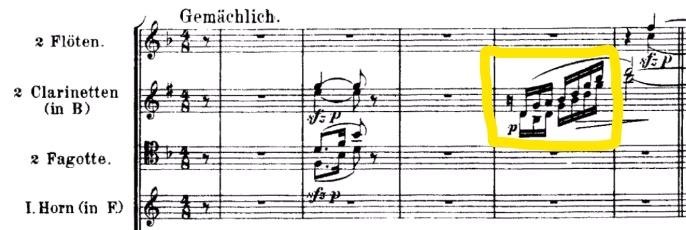
That said, I have encountered some passages or motifs where two oboes are in unison, proving the rich variety of the instrumentation from Strauss.
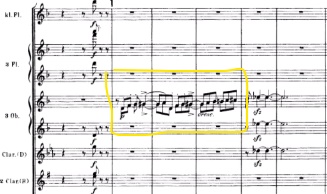
The work has some modern quality, like in section 14, where the Hons and Trumpets sound like George Gershwin’s themes, very contemporary and Jazzy. See the example below.
There was one device explained by my tutor regarding the application of dynamic and texture in some extreme cases. Below there is an example of ff tutti to p solo instrument.
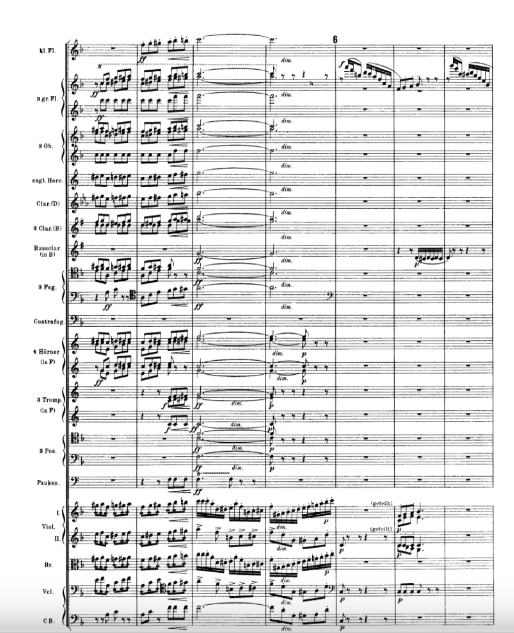
On page 33, the percussion section, most relevantly, the timpani reminded me of The Planets (1917) by Holtz (1874-1934) in the application of rhythms. There was a section that grabbed my attention at minute 4:00. The instrumentation applied by Strauss was 2 Horns, 3 Bassonss, 1 Bass Clarinet and 2 Clarinets. The sound produced was very calming and dense.
Beethoven (1770-1827) – Symphony n.7 in A major, Op.92 (1812). Berlin Philarmonic 1977. Accessed on 07 March 2023 from: https://youtu.be/JMrm9jEo_Pk.
Beethoven’s Symphony n.7 begins with a woodwind-centred melody. The composition seems to be based on repetitive cells and motifs applied within the rules of tonality. The work combines very quiet passages with very loud and powerful moments. This power that Beethoven seems to apply to the symphony is due to the crescendos and the power of all instruments playing simultaneously in fortissimo. There is a considerable balance of textures, from very light and solo instruments to heavy textures. bb 242-246 are a good example of heavy texture. These extremes and abrupt contrasts in power, dynamics and textures seem to be the composer’s signature. The percussion section adds intensity to work and helps create a powerful output. The instrument usage in some sections and statements is based on imitation counterpoint and sequences. There’s an example of syncopation in b.171. The composer seems to balance the use of instrumentation in every section. I also noticed a section where the only instrument assigned with the melody was the 1st violin. All other instruments were either supported harmonically or as decoration. I felt the orchestra’s power was wrapping the melody so it could not be heard properly. Perhaps is the composer’s intention. However, I feel it could have benefits for the addition of second violins in octaves or unison. In the second movement, the conjunction of the cello and viola in unison performing the melody was felt to be quite interesting and moving. Also, I noticed the clarinets in octaves, perhaps to widen or thicken the orchestra sound. I feel the orchestration of this work can serve as a stepping stone towards my understanding of general practice and techniques.
Anna Clyne (1980-Present) – Masquerade (2013). Performed by BBC Symphony Orchestra. Avie Records. Accessed on 12/03/2023 from: https://youtu.be/wEOchchAuWk
This work by composer Anna Clyne strongly resembles film music by various composers, including the soundtrack by James Horner (1953-2015), The Mask of Zorro (1998) and Stargate (1994) by David Arnold (1962-Present). The work seems to portray six or seven scenes in which the material appears to interwave in a variation-like method. This form of composition was encountered before in the work Le Onde (1996) by Ludovico Einaudi (1955-Present). There are plenty of emotions in work. However, due to the shortest of the sections, there seems to be no continuity in the thematic material. The coherence seems to be found in the repetition of some themes and recognisable sections. Although not completely atonal, the work appears to lack a tonal structure in a strict home-away from home-home environment. There exist instances of syncopated rhythms marked and accented by the percussion section. Something that caught my attention was the descriptions of the sections. Some of these descriptions seem to follow specific instrumentation. Examples are soaring with grandeur, in which all instruments seem to perform long notes. Lilting but ominous, in which the strings and woodwind sections seem to have the principal role. And vigorous and thorny, in which the accented dynamics with fast semiquavers are performed by strings, horns and woodwinds. The work ends with a big crescendo. The piece feels fresh and entertaining as a mix of soundtracks and short scenes, also approaching various old styles of music like folk. The work is envigorating and powerful at times.
Florent Schmitt (1870-1958) Legende for Alto Saxophone and Orchestra (1918). University of Southern California Thornton Symphony. Accessed on 12/03/2023 from: https://youtu.be/MHJmHAPFrnQ
The first characteristic that stood out in this composition from Florent Schmitt is how similar it was in style if compared to The Planets (1917) by Holtz (1874-1934). What it seems that vast amounts of works contemporary of Holtz and after his time are comparable. Although it is true that a masterpiece and a grandiose work like Holtz’s The Planets is difficult to surpass, Legende for Alto Saxophone and Orchestra has devices and characteristics to become a stepping stone in composition and analysis. The use of instrumentation appears to be disjoint. Rather than utilising many instruments to perform together, Florent seems to apply one instrument at a time. There appears to be not much repetition in the work. The coherence appears to be in the balance of the orchestra’s timbre. Like what I considered the ‘psychedelia in classical music’, this work does not seem to follow any chordal or tonal hierarchy. However, employs chromatic, and non-chromatic scales, in addition to grammatical devices like chords, to support coherence. The sense of the piece is rather obscure and enigmatic, perhaps taking the listener to the insides and dark side of the composer. By choosing an Alto Saxophone, the composer tries to exploit the obscurity and darkness of the instrument and, at the same time, take advantage of his trumpet-like sound in the high registers. I noticed in b. 3 a divisi mark on strings and octave divisi in the violins further in the work. The cello and double bass were also noticed to be written in octaves in some passages, and the Horns in thirds. It was also noticed that the Brass section was applied when seeking to produce excitement between sections. The more I listen to the piece, the more I seem to comprehend the content and purpose of the devices produced by the composer. It has been a great experience, and I will consider this work for content, device application and analysis for future works.
Vangelis (1963-2022) — 1492 Conquest of Paradise (1992). Orquesta y Coro de “Voces para la Paz” 2013. Accessed on 12/03/2023 from: https://youtu.be/lZSxDoizLfU
This is an arrangement for Orchestra and a Choir of the theme for the film Conquest of Paradise by Vangelis. Due to the nature of the arrangement, most of the emphasis has been directed to the voices. On the contrary, other arrangements made, like the one by John Williams for instance, focus on instruments rather than choir. The theme is assigned to the Brass in first instance. Link here. John Williams’ arrangement also lacks the power of ‘voces para la paz’, due to the vast size of the choir of the second. The original soundtrack employs samples of renaissance instruments, perhaps it would have been appropriate to perform with similar instruments, althght it seems that the percussion it does in fact employ a drum from the era. The percussion appears to act as a continuo playing. There seem to be few more phrases added to this arrangement that do not exist in the original. Two sections, at the begining and at the end was noticed. Additional notes were added and the end extended for a few bars. This is one of my favorite themes, an extraordinary lifting and motivational score that brings lots of memories. I had in mind to produce an arrangement of this particular soundtrack and I feel more motivated after finishing this part of the module thanks to the knowledge adquire and the listening.
Listening part 3
Ben Webster (1909-1973) – Duke Ellington Orchestra – Cotton Trail (1940). Accessed on 19/04-2023 from: https://youtu.be/uzMhGj-YXww
Ben Webster’s version of “Cotton Tail” appears to be a high-energy jazz composition with a driving swing feel that propels the music forward. Webster seems to be a virtuoso of the saxophone. He applies techniques such as vibrato, articulation, phrasing, dynamics, and blues and swing phrasing. In using these techniques, he produces a distinctive sound and feel. His playing appears to be characterized by a deep, rich tone and his ability to play with great emotion and expressiveness. One notable feature noticed is the use of octaves, which he employed to create a fuller and more powerful sound in his solos. The saxophone interacts with the rest of the orchestra throughout the song. The other instruments seem to accent the melody and the end of phrases. The energy of the music is evident. However, Webster’s performance in some phrases produces a relaxed and laid-back feel, perhaps creating contrast. Webster’s use of dynamics is also noteworthy in this work. He plays with a great range of volume and intensity, moving seamlessly between quiet, introspective passages and fiery, high-energy sections. The textures of Ben Webster’s version of “Cotton Tail” can be described as layered and complex. The saxophone provides the leading melodic and soloing voice, while the other instruments provide harmonic support and rhythmic drive. The textures constantly change throughout the song, with the quartet moving seamlessly from the whole ensemble playing to individual solos and back again. One example of a textural change in the song can be heard during the saxophone solo in the middle section of the piece. During this solo, the rest of the quartet drops out briefly, leaving only the saxophone playing, creating a more sparse and intimate texture. The quartet then gradually returns, building the texture and momentum of the song back up to its energetic and driving conclusion. The composition’s virtuosity of the performer, the flawless shifts in dynamics, textures, and rhythmic feel, along with the driving force of the entire orchestra, were highly appealing. Although I am not an ardent follower of jazz music, I recognize that it could present a new frontier to explore the diverse range of rhythmic possibilities.
Maynard Ferguson (1928-2006), Stan Kenton Orchestra – Artistry in Rhythm (1946). Accessed on 25/04/2023 from: https://youtu.be/msEqWQuAVXk
“Artistry in Rhythm” is a classic big band jazz tune composed by Stan Kenton, featuring a memorable trumpet solo by Maynard Ferguson. The song was first recorded in 1946 by the Stan Kenton Orchestra. The introduction of the work seems to set the stage featuring a dramatic and ominous brass fanfare played by the trumpet and trombone. It feels syncopated, legato and staccato. After a little introduction to the theme, there appears to be a drum solo using a few techniques, including rolls and a small fill. The jazz characteristics can be heard throughout the song, including dissonances, tensions, swung notes and blues notes. There is a small piano solo as well before the main role is gained by the trumpet, saxophone and trombone in octaves which appears to provide high-energy phrases and virtuosity playing. Another aspect of the work is the use of dynamics with a great range of volume and intensity from quiet to very loud, adding excitement to the piece. The bass line that is a characteristic of the Baroque continuo appears to be played by the double bass in Jazz Orchestras. Although the piece didn’t immediately catch my attention upon first listening, repeated listening allowed me to appreciate the jazz syncopations, blue notes, and other intricated characteristics of the composition. I enjoyed the piece due to its energetic performance and the clarity of the musical language used.
Carla Bley (1937-), Metropole Orkest – O Tannenbaum (2011). Accessed on 25/04/2023 from: https://youtu.be/vVH59DYP4GM
This arrangement seems to be coming from a classic German Christmas carol. In this arrangement, the Jazz composer approaches it for cello, marimba and accordion, which in itself appears to be a non-conventional choice of instruments. However, it creates a very unique and warm sound. The cello provides rich and resonant bass timbre. Also seems to be adding depth and texture. However, also provides melodic counterpoint support to the melody providing interest. The marimba provides high pitches and bright sounds. However, also provides melodic material to the piece and contrasts with both the other instruments. The accordion provides midrange, full and sustained sounds. It appears to be in charge of the chords and harmony. However, like the other two instruments, there are times when they also play counter-melodic material, balancing the use of the instruments in this arrangement. The Jazz syncopation can also be heard as some subtle harmonic shifts and unexpected rhythmic twists, providing a sense of playfulness and spontaneity. The dynamics in this piece of music appear to increase gradually, leading to a climactic and descending end. Although I admire the composition for its balanced instrumentation and skilful use of individual instruments, I feel it can be viewed as somewhat distorted from the spirit of the original carol. This deviation from the original, however, adds an element of interest and provocation to the piece. By experimenting with unconventional rhythms and harmonies, Bley’s challenges the listener’s expectations and encourages a fresh perspective of a classic tune.
Toshiko Akiyoshi (1946-) – Long Yellow Road (1957). Accessed on 25/04/2023 from: https://youtu.be/-4yKGoSFrD0
“Long Yellow Road” is a jazz composition by Toshiko Akiyoshi that was first recorded in 1957. The composition features a bright and upbeat melody with a driving swing feel. The composition begins with a catchy riff played by the brass section, setting the tone for the rest of the work. Akiyoshi appears to be playing the piano and conducting the band. The tune features several solos, including what seems alto saxophone, standard saxophone and a trumpet. Both saxophone solos are full of virtuosic and expressive qualities. The techniques used appear to be double tonguing, slurring, vibrato, staccato and legato, providing variety to the work. The introduction of the trumpet adds a brighter characteristic to the piece, and it must be said the trumpeter reaches very high pitches. The music is characterised by frequent start-stop moments, creating a syncopated and somewhat uneasy feeling that adds to the overall dynamics of the piece. There seem to be far keys chord changes, which add depth and complexity to the work. The rhythmic feel of the composition is also unique, with the brass section playing accents and syncopated rhythms that kept me on my toes. There seems to be a good balance of very quiet performance with other forte sections that provide excitement to the piece. I have also noticed the ritardando at the end of the piece. Overall I enjoyed the piece as a whole, as the composition is well-balanced in terms of dynamics, instrumentation, and virtuosic solos, with many exciting sections that add to the piece’s energy.
Johannes Brahms (1833-1897) – Waltz in A flat major, Op. 39 No. 15 (1865). Performed by Cziffra György(1921-1994). Accessed on 27/04/2023 from: https://youtu.be/6Oy0w7eLgRk
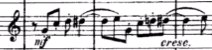
Johannes Brahms’ Waltz in A flat major, Op. 39, No. 15, is a charming and graceful piece. The composition has a 3/4 time signature typical signature of a waltz. There is a lyrical melody played by the left hand, whiles the right hand is mainly used for accompaniment and harmonic purposes. This Waltz begins with an elegant melody in the right hand with a series of arpeggios in the left hand. The melody appears to be syncopated and is altered through the piece by a series of variations, including diminution, which creates a sense of rhythmic tension and excitement that adds to the impact of the music. Brahams also appears to use harmonic variation using chord inversions and modulation to create interest. There is also the use of ornamentation in b.3, as shown in the picture below.
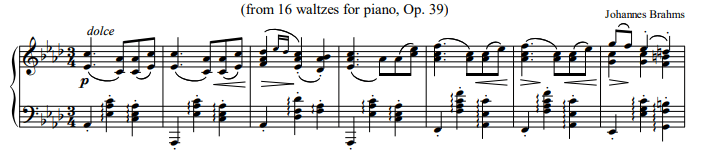
Brahms skillfully employs a variety of dynamic markings, such as crescendos and diminuendos, through the Walz to enhance the sense of excitement, anticipation, and the expectation for a climactic melodic resolution. These dynamic changes add to the emotional impact of the music, creating a sense of tension and release that engages the listener and highlights Brahms’s craft. Thought the work, I noticed how the composer applies contracts in addition to the above illustration. He also uses articulation contrast, legato and staccato and different tempos, such as slowing down or speeding up the music. Overall I feel it is a delightful and well-balanced Waltz worth learning to play on the piano and useful for learning the approach to orchestration in terms of harmonic variety, dynamic treatment and rhythmic flow.
Incognito (1979-), Always There (1991). Mercury Records Limited. Accessed on 27/04/2023 from: https://youtu.be/X6JM8iagb8o
Incognito’s “Always There” featuring Jocelyn Brown have a sense of soul, funky and some Jazzy grooves. The music begins with a bassline setting the tempo of the song. The brass section that comes in adds jazzy and upbeat elements to the song. The voice seems to be powerful and soul-like, powerful, emotional and gospel-like influenced sound. Jocelyn Brown’s vocal techniques seem to include melisma and vibrato, adding a deep feeling to her singing and complementing the orchestration. Thought the song, the brass section plays staccato riffs and accents that punctuate the rhythm and adds energy to the song. The brass section is particularly prominent in the song’s intro. The catchy chorus seems to be talking about love and support, both elements of emotional and sensitive human-related experiences. The song reminds me slightly of the singer Rich Ashley (1966 -) and his most recognised songs like ‘never gonna give you up’ (1987). However, the latest seemed to be more polished and commercial to attract more sales in the general market. Each song uses technology and keyboards to produce a clean and outstanding mix, well-balanced, allowing each instrument to be heard clearly and distinctly. Altogether the genre of the song is not my personal favourite. However, listening to it with a more analytical perspective allowed me to appreciate its various styles and how the instruments and vocals interact with each other. It was an insightful experience to delve deeper into the song’s production and arrangement. I feel I have gained a newfound appreciation for the technical skills and creativity involved in creating the song.
Maurice Jarre (1958-2001) – Annunciation (1977). Accessed on 29/04/2023 from: https://youtu.be/r4QsM2NL8DQ
Annunciation is a beautiful and haunting composition by the French composer Maurice Jarre, well known for his works in film scores. The piece was composed in 1977 and is a musical interpretation of the biblical story of the Annunciation, where the angel Gabriel appears to Mary to announce that she will bear a son. Although this composition, as all the film music, is best understood accompanied by the visual material, the different sections and moments in the piece can easily portray the essence of the biblical story. From the listening, I could discern various effects like practice-like runs by the woodwinds and muted brass. The instrumentation itself seems to be an orchestral standard. In addition, there seems to be a sitar, and the most notorious instrument seems to be the application of Theremin, which adds to the music this divine sense and ethereal sound. The composer balances the melody using all sections of the orchestra. However, the woodwinds and especially the flute seems to have a prominent role. Despite the complexity of the nature of the story, Jarre seems to approach the composition of the piece with simplicity, mainly using octaves between instruments. This approach perhaps gives the piece a timelessness property. In essence, it’s a 2000-year story! The piece’s dynamics are also well balanced, with a soft approach to phrases and gradually building intensity. The dynamic also adds a sense of drama, awe and wonder. I have enjoyed this piece since Jarre blends Easter and Western musical traditions using Sitar and Theremin alongside orchestral instruments. This combination has produced a unique sound that enhances the otherworldly atmosphere of the piece. In addition, how the melody and material are passed from one instrument to another intensifies the sense of communicating the divine biblical event. Overall, I feel that the composition is well-suited for its intended purpose and showcases great creativity.
Kirk Whalum (1958-) – Ascension (1998). Craft Recordings. Distributed by Concord. Provided to YouTube by Universal Music Group. Accessed on 29/04/2023 from: https://youtu.be/d_fUT_asQGs
Ascension is a smooth jazz song by American saxophonist Kirk Whalum. The song seems to feature a blend of smooth jazz, gospel, and R&B styles. The point where all those stylistic characteristics of the genres come together appears to be the use of improvisation, repetition, strong vocal harmonies and emotional expression. The use of melodic counterpoint in voices is a technique often associated with gospel music. The grooves with a strong backbeat provided by the rhythm section are typical of R&B, while the syncopated rhythms are connected to Jazz music. The dynamics and contrast seem to be very effective in the composition. The soft and introspective beginning of the song contrast with the energetic, exuberant chorus, creating, in a way, a sense of tension and release. The tone of the saxophone is very smooth and warm. Kirk appears to display a diverse range of techniques and pitches to create an interesting and dynamic piece. One technique that stands out is the long sustained notes, producing anticipation and excitement. Overall, I enjoyed the piece due to the uplifting feeling produced by the groove and the warm and highly energetic tone of the, at the time, very lyric performance of the saxophone by Kirk.
Listening part 4
Anna Maria of Prussia (1836-1918) – Flute Sonata in F major (). Accessed on 12/06/2023 from: https://youtu.be/F5QfFy5rCgQ
This is a Sonata in F major for solo flute and harpsichord. The sonata form seems composed of three sections, Adagio, Allegretto and Allegro ma non troppo. The flute has the primary role in the work, while the harpsichord functionality provides support as basso continuo, an indicative element of the baroque stylistic orchestration. Other baroque-style elements are present, like rich ornamental melodies. The flute has some virtuoso passages that portray the composition’s difficulty and ingenuity. The coherence of the work is set in tonal functionality as per the period of composition. The excitement is constantly set by the accents and dynamics. The construction of motifs, phrases and sentences is exquisite, with outstanding charisma, and greatly appreciated. In addition to listening to the techniques of composition, instrumentation and analysis, the history of Anna Maria was fascinating. It appears that the princess’s passion for music took her to learn secretly from his younger brother, as women were not allowed to take formal education in music at the time. This determination provides motivation and drive to follow anyone’s dreams in life and music career.
Reference:
Raine-Wright, A. Insusion Baroque. Anna Amalia. Accessed on 13/08/2023 from: https://www.infusionbaroque.com/anna-amalia-en-914903-628327-999245.html
Darcy James (1968-) – Brooklyn Babylon (2011). Accessed on 10/06/2023 from: https://youtu.be/NMWqllG3Tkk
This composition by Darcy James, designed for an 18-instrument band, displays the composer’s innovative approach to music creation. The instrumentation is five separate wind ensembles, 2 brass ensembles, electric guitar, piano, electric bass, and drum set. Through the fission of jazz, contemporary classical, and big band elements, James crafts a distinctive and vibrant sound in this particular work. The intricate rhythms and the apparent improvisation are elements of jazz. The repetition in the foreground at the beginning and in the background during most of the piece provides the elements of contemporary classical music. In addition, the big band elements are present in the energetic and bold brass section dynamic arrangement. The piece’s highlight on a personal level is the clarity with which all these elements are fusion. James creates an individual and distinctive section, but at the same time, coherence exists. The use of repetitive elements reminded me of the work by Phillip Glass’ Train 1. Using repetitive patterns, James seems to explore the evocative nature of trains and the bustling routines of a city. The heavy use of variable meters is another element of contemporary classical music.
References:
Band Camp. Brooklyn Babylon. Accessed on 23rd May 2023 from: https://darcyjamesargue.bandcamp.com/album/brooklyn-babylon
Depeche Mode (1977-present) – Personal Jesus (1989). Accessed on 14/08/2023 from: https://youtu.be/dj9U3QLTd1c
Depeche Mode is an English electronic band formed in 1977. The song Personal Jesus was released in 1989, marking one of the most iconic periods of the band. The instrumentation chosen for the song is drums, synthesised keyboards, guitar, bass, and vocals. The song has a distinctive guitar riff, which serves as the fundamental element along with deep and soulful vocals. The drum pattern appears to be persistence very much the whole song, creating perhaps a religious repetitive pattern. The synthetaser provides the song with a layer of atmospheric sonic, dark colour contrasting with the guitar patterns. The rhythm and groove of the song contribute to the dance feeling. The lyrics in Personal Jesus explore with themes of faith, devotion, and the complexity of relationships. It will seem that Depeche Mode lyrics allow for multiple interpretations. Among those interpretations exist the possibility that he portrays himself as personal guidance and salvation, which can also be interpreted as a more religious experience. Perhaps this duality adds to the success of the song. On a personal level, the song is appreciated, and although I do not follow this style of music, I understand the contribution of the band in the history of music by fusioning synths, electric and pop music.
Harrison Birtwistle (1934-2022) – Earth Dances (1986). Accessed on 07/08/2023 from: https://youtu.be/c6CXGylK5gI
This is a major orchestral composition completed in 1986 with a powerful orchestration due to his dynamic changes, articulations and combination of instruments. The work appears to be inspired by the idea of the natural earth’s forces and cycles of nature. Its form is divided into six ‘strata’, whose changing relationships reflect those of the earth’s geological layers [1]. Birstwistle seems to apply a lot of effort and detail to the composition of the percussion section, which appears to have a primordial role. The composer also seems to offer an immense amount of rhythmic cell changes, perhaps evoking contemporary works like Stravinsky’s (1882-1971) The Rite of Spring (1913) in my mind. Other composers that came to mind were Richard Wagner (1813-1883) in his work The Ring Cycle (1874) and The Lord of the Rings (2001) soundtrack by Howard Shore (1946-present). The complete work is undoubtedly atmospheric and a cinematic-sound experience. It is worth mentioning that the film Predator (1987), directed by John McTiernan and Scored by Alan Silvestri (1950-present) was produced merely a year later than Bristwistle work, and both share an astonishing similar orchestration and enigmatic energy. On a personal level, although I was amused at the amount of variety and rhythmic changes, I felt the work would benefit from visual support, which nowadays would be easy to produce with the tools like youtube.
Reference:
[1] The Rough Guide to Classical Music. Dorling Kindersley Ltd. 2010. pp. 84–85
Ross, A. Birtwislte’s Earth. Accessed on 07/08/2023 from: http://www.compositiontoday.com/articles/birtwistle_earth.asp
The editors of Gramophone. Britwistle Thesous Game Earth Dances. Accessed on 07/08/2023 from: https://www.gramophone.co.uk/review/birtwistle-theseus-game-earth-dances
Jean-Michel Jarre (1948-) – Oxygène (1976). Accessed on 12/08/2023 from: https://youtu.be/BznDy7bxl9M
This work by Jean-Michel Jarre is probably the most iconic work from his album. He uses a synthesiser and electronic instruments, like silent cymbals, to achieve a sonic landscape that gives the listener a sense of joy and hope. The track begins with a pulsating bass line that evokes a Renaissance dron. This device establishes the rhythm foundation and is kept throughout the work. Jarre adds layers of sounds upon this foundation, using sweeping pads, arpeggiated sequences and resonant leads to create variation and keep the interest. A memorable melody is also layered and repeated throughout the piece. This repetition and variation in the layers of sound give coherence to the work. The melody seems to be a simple yet effective two-piece motif. Although this piece is modern, the fundamentals of it are based on harmony and easy-to-understand writing that connects with the listener effortlessly. Jarre also appears to alter the timber of the melody, perhaps imitating the orchestral call and response device among flutes and oboes or clarinets. The piece has a sense of moving forward due to the harmonic progression reaching a climax around halfway to the piece and again towards the end. Jarre, whose father is a well-known film composer, seems to choose the contemporaneous wave of electronic music for his instrumentation rather than the orchestral approach. However, in a very eloquent and minimalistic way of writing, managing to popularise it and making it easy to comprehend for the general public, achieving this way a notorious and prominent place in the history of electronic music.
Jimmy Lopez (1978-) – Fiesta (2011). Accessed on 19/04-2023 from: https://youtu.be/uzMhGj-YXww
This composition by Jimmy Lopez presents a modern and innovative approach, predominantly the condition of rhythmic cells that flow seamlessly from one instrument to another. Lacking a traditional harmonic hierarchy gives the piece a unique and modern character. The orchestration weaves together various elements, evoking an atmospheric presence that occasionally hints at rhythmic influences from salsa, merengue and samba. The strategic use of congas and bongo drums adds a distinct South American flavour, ingraining the composition with cultural richness. The rhythmic frame plays a vital role in this musical creation, with accented beats serving as a backbone. Surprisingly, all instruments support one another without any single one taking the primary role as such. The composer produces waves of texture and colour, blending the instruments. However, the cellos and the brass have a prominent role, and the violins are also very active. Although the overall modern form of the composition might not align with personal preferences, It undeniably delivered an exciting, vibrant and dynamic orchestration.
Maryanne Amacher (1938-2009) – Intercept (1983). Accessed on 08/08/2023 from: https://youtu.be/JXkwfbaaO_U
Maryanne Amacher’s is a significant work that explores the relationship between architectural spaces and sonic environments. The work appears to be a collection of sound installations designed to engage listeners in a dialogue with their urban surroundings using dedicated FM-quality analogue phone lines. This work has a spatial element, as the sounds reach distant parts of the USA. In that sense, the work experiments with an innovative idea of the relationship between sound, space and perception. The project seems to have more of an experimental approach to electronics and sonic art than tonal music. There seem to be only a few layers of perceptive sounds, a low pass and a high pass, similar to those in the equaliser filters. However, some perceptive familiar sounds are in some ‘sections’ of the work and at the end of the tape recording. Although amusing at first and having an implication for contemporary music using technology elements, on a personal level, the experiment does not keep up the interest beyond the importance of the investigation and research in sound producing and recording. That said, the work’s process and intentions are understood and have given me insight into that contemporary period of music history.
Reference:
38, Ludlow. 2010 Maryanne Amacher’s City Links. Accessed on 08/08/2023 from: https://ludlow38-archive.org/exhibitions/maryanne-amacher-city-links/
Tōru Takemitsu (1930-1996) – November Steps (1967). Accessed on 13/08/2023 from: https://youtu.be/qcT_j9Dzt9Y
November steps is a significant work by Japanese composer Toru Takemitsu. The work’s uniqueness, among other elements, appears to be merging Western and Eastern musical instruments, creating exciting and vivid sonic landscapes. The composer employs The Shakuhachi, a bamboo flute derived from the Chinese xiao in the 8th century [2], and a Biwa, a Japanese lute related to the Chinese pipa, to create a sense of Eastern moments. Takemitsu also employs the traditional Western orchestra. Most of the composition thought, concentrating on single long notes to express the stillness of emotions using Japanese instruments. The use of silence is also a primordial role in the composition of this work. It will appear that the form is two continuous sections, each of those concentrating on a solo Japanese instrument. However, there are moments of interplay between the instruments and the orchestra. The work seems to also include contemporary Western dissonant elements evoking those of Schoenberg, building an atmosphere of uneasiness and complex harmonies. The texture and atmosphere appear to be created by the interplay of the biwa and orchestra, the shakuhachi and the orchestra, and the orchestral instruments blending together traditionally. November Steps also seem challenging to perform due to the extended technique appreciated, especially at the beginning of the work, making it only playable for a professional orchestra rather than an amateur. On a personal level, the work has helped to further understand the importance of combining different instruments to produce a unique sound when orchestrating. It has prompted in my head various potential projects for my future portfolio.
References:
Britannica, The Editors of Encyclopaedia. “biwa”. Encyclopedia Britannica, Invalid Date, https://www.britannica.com/art/biwa. Accessed 13 August 2023.
[2] Britannica, The Editors of Encyclopaedia. “shakuhachi”. Encyclopedia Britannica, Invalid Date, https://www.britannica.com/art/shakuhachi. Accessed 13 August 2023.
Listening Part 5
Le Six (1920) – Les Maires de la Tour Eiffel (1921). Accessed on 15/10/2023 from: https://youtu.be/7zc2FirtReE?si=cmfIkr_-5SYWebzX
Le Six emerged with a clear rejection of German Romanticism and the lush Orchestration by Debussy (Britannica) It was composed by Darius Milhaud (1892-1974), Francis Poulenc (1899-1963), Arthur Honegger (1892-1955), Georges Auric (1899-1983), Louis Durey (1888-1979), and Germaine Tailleferre (1892-1983). This particular composition by Le Six appears to be distinguished by some fundamental characteristics that make it different from the trend of the Romantic era. The size of the Orchestra does not seem to be a large one. This allows the textures to be perceived clearer. The Orchestras in the Romantic era appear to be large in size as in Wagner’s (1813-1883) and Mahler’s (1860-1911) orchestras The instrumentation of Les Six also includes sirens and typewriters as in the work Parade (1917). This will make the piece unconventional with new additional sounds for the era. Could this unconventional orchestration have been the predecessor of John Cage’s (1912-1992) extravagant Water Walk (1960), Ameriques (1921) by Varese (1883-1965) or Leroy Anderson’s (1908-1975) Typewriter (1950)? The percussion section seems to play a major role with striking drive and adding colour. I feel that the genuine originality of the composition, and indeed the group is the fact that there are actually six composers, each one adding their own idiom and perspective in musical partnership. Although out of place and time, this composition can be very useful to discover new ways of juxtaposing a variety of styles of music and in the pursuit of creating a unique idiom.
Reference:
Britannica, The Editors of Encyclopaedia. “Les Six”. Encyclopedia Britannica, 13 Aug. 2012, https://www.britannica.com/topic/Les-Six. Accessed 21 October 2023.
Sunam, D. 2019, Pedagogical Thoughts on Album des Six: a piano set by Les Six to represent French
Nationalism. West Virginia University.
Igor Stravinsky (1882-1971) – Petrushka (1911). Accessed on 17/10/2023 from: https://youtu.be/Fzp89DVuUlI?si=SlreAg2xMZxp3sIZ
Igor Stravinsky’s Petrushka does, as many of his other compositions, push the boundaries of traditional orchestration techniques. The composition is characterised by the diversity of colour and rhythms. Stravinsky opted for a large orchestra. The composition itself is very complex but somehow simple as it relies almost entirely on rhythmic cells. That said, it sounds more consonant and with more melodies than his later work The Rite of Spring (1913). Petrushka like any other ballet music, must mimic what is on the stage, therefore sometimes the sound produced by the whole orchestra is chaotic and fantasy infused. By far the most noticeable element of the composition is the use of dissonances. The composer chose to use a piano, whose colours and dynamic palette add to the whole experience a sophisticated touch. He appears to apply unconventional scales and harmonies, which brought to mind later atonal works at the piano like Sally Beamish’s (1956-Present) Hill Stanzas (2016). Stravinksy seems to apply different instruments or a melody to each character, using each particular timbre to further identify and represent the aural and visual experience. The percussion has a primordial role in this composition as it does in other of his works. The composer balances the usage of all instruments, so all musicians have a moment to shine. It seems that Stravinsky makes extensive use of the bassoon for melodic passages. The addition of extended techniques and unusual instrumentation like bass Clarinet, contra-bassoon and English Horn, provides the composition with unique character. I enjoyed the work due to its uniqueness of timbre, extended techniques applied to the instruments and the variety of dynamics, elements of surprise and overall balance between all the elements of musical composition and orchestration.
Maurice Jarre (1924-2009) – Shogun Soundtrack (1980). Accessed on 10/10/2023 from: https://www.youtube.co/watch?v=56FK7m8V38glist=OLAK5uy_n7BjyaE3F_jkTtwoAwjLFgewuhYg39VTE&index=1
I recently revisited the series Shogun and I quickly made a connection between the soundtrack and the exercise world orchestra. Jarre creates a soundtrack where cultural and traditional Japanese are sensitively portrayed in music. To achieve this, Jarre incorporates traditional instruments and melodies into his composition, providing authenticity and a true approach. The main theme reminded me of composers like Miklos Rozsa (1907-1995) the soundtrack El Cid (1961) and the intro of Alfred Newman’s (1900-1970) All About Eve (1950). One of Jarre’s signatures in orchestration is the use of quite tremolos in the background, normally produced by the string section. Jarre gives emphasis to the percussion section in the soundtrack. He doesn’t solely use the percussion instruments for accentuation purposes, rather he chooses to give a main role in this composition. Other orchestration features of Jarre’s signature appear to be the use of trills and octaves in his melodies. To create a Japanese sense, Jarre uses drums and gongs, cymbals, traditional flutes and what seems to be a shamisen, which resembles a lute. In addition, the application of oriental scales creates a Japanese atmosphere. However, Jarre does not merely use Japanese instrumentation. He forges the Western orchestra with the Japanese instrumentation to create an interesting and coherent soundtrack. I was delighted by the idea of of mixing different world instruments, and I have already applied them in some of my compositions, however, doing this listening has opened a new way to introduce different aspects of world music to my music.
References:
https://livejapan.com/en/article-a0001807/ Accessed on 10/10/2023.
Hanz Zimmer (1957-) – Gladiator Suite (2000). Accessed on 17/10/2023 from: https://youtu.be/t4qkkd_pJKc?si=R24WOkRaImt1xoBo
Hanz Zimmer’s Gladiator is a well-known film composition that has many orchestral similarities with The Planets (1916) by Gustav Holtz (1874-1934). The most striking similarity is in section three where the strings play a repetitive note in staccato the brass takes in the main melody. The Orchestration itself appears to be simple light textures. The textural interest increase due to the added balance of instrumentation like in the first section where the brass takes the main melody and the woodwind provide supportive harmony and at the same time adds colour to the melodic element. This unity of the brass and woodwinds creates unity and a variety of tone colours at the same time. The strings in the first section appear to be providing background accompaniments while the timpani and snare provide drive forward to the music. The use of exotic scales at the beginning also aids the creation of an atmospheric foreground. Zimmer’s choice to introduce the second section is an ascending scale in order to create interest and tension. It was noticed that the bass drum player had two sets of sticks, and soft and one hard. It will seem that the choice of beater will be used according to the passage or section. The Cymbals seem to have an accenting purpose sometimes announcing the end of phrases or sections, like when entering section four. However, towards the end the Cymbal hold greater importance, increasing the dynamics to ff with a wide open release creating in that way brilliance and using all the space available. The cellos appear to have an emotional impact, especially in the fourth section. Using heavy vibrato the emotional element is enhanced greatly. In that particular section, the melody is passed from the cellos to the trumpets, creating contrast and interest in the use of space and timbre. Towards the end section, the strings are used to create tension using trills and forte dynamics. There exist moments of great dissonance where Zimmer’s orchestration appears to be tutti increasing dynamics gradually in the form of a crescendo adding tonal weight and excitement. Overall, I feel the orchestration is balanced and interesting, the planes of harmony are distinct and respected and there’s a good balance of sonority.
Louis and Bebe Barron (1920-1989)(1925-2008) – Forbidden Planet (1956). Accessed on 01/10/2023 from: https://youtu.be/aryHMPH7Kcc?si=wqQmqGj2jTSzHyEl
Bebe Barron was a forerunner on electronic sound development for film music as presented in Forbidden Planet. Bebe seems to have been formally educated in music studying composition and ethnomusicology at the University of Mexico (Scharder 2008). Louis was also educated in music at the University of Chicago. According to a The New York Times article, both cooperated on concerts and on such Broadway productions as Visit to a Small Planet, The Happiest Girl in the World and The Chinese Wall. In Forbidden Planet, we are presented with a variety of sounds, all of which seem to have been produced electronically. It is unknown to me if any instruments of the orchestra could have been recorded, modified and edited to obtain any of the sounds. However, from the clip listened to on YouTube only electronic sounds are perceived. Among those sounds, are sirens, electric blobs, sounds of descending aircraft, and what could seem as high-pitched electronically manipulated waves. The connection with traditional music can be regarded by the repetition of sounds, layering of sounds to the foreground and background, use of dron and dynamically ascending crescendos in some layers. Nowadays, this form of composition might seem primitive in terms of what sounds can be created with computers, however, the novelty of the soundtrack created such an impact that licencing royalties in America did not want to recognise the soundtrack as actual composed music with musicians.
Reference:
The New York Times. November 17, 1989
Barry Schrader (April 29, 2008). “Electronic Music Pioneer Bebe Barron Dead At 82”. Synthtopia. Retrieved 2010-10-01
https://www.allmusic.com/album/forbidden-planet-original-motion-picture-soundtrack–mw0000203771
Chaya Czernowin (1957-Present) Hidden (2017). Accessed on 31/10/2023 from: https://youtu.be/YJOv2GcVOoc?si=9DJRakPXZ_b1WVAo
Chaya in Hidden presents a work of sonic art perhaps representing the hiding sounds that can be produced from traditional instruments normally not performed. In the same manner of contemporary composition as Helmut Lachenmann (1935-), Chaya utilised only extended techniques from the instruments, mainly perceived as strung and electronic devices. It will seem that the composer’s focus is on space and gesture. The composer creates uncertainty about what sonic layer will become foreground or background in an ensemble of sounds. As per the composer’s words, she wanted to create an ‘Etude in Fragility’ with her cycle of works for voice and breath. In most of these types of contemporary compositions, the imagination plays a great part in understanding what is the purpose of the work. I feel that this work may expand the sensorial perceptive systems of the listeners. However, an explanation of what is intended from the work of sonic art is always an advantage to receive. Perhaps the more I listen to these kinds of compositions the more I will understand them. Some of the sounds can be decrypted as rainwater and some others as a swarm of wasps, perhaps trying to imitate as many composers’ nature through instruments and electronics. Although was interesting to learn about the composer and the work, it will not be part of my everyday preferences in music.
Reference:
https://naxosdirect.co.uk/items/chaya-czernowin-hidden-427717 Accessed 31/10/2023.
Aman Khachaturian (1903-1978) – Sabre Dance (1942). Accessed on 30/10/2023 from: https://youtu.be/gqg3l3r_DRI?si=EW6rpdQzf3Zyweps
According to Helper and Wasatch, Khachaturian stayed in Yerevan in 1939. He composed the ballet Schast ‘ye. He then extremely rewrote it, creating the Gayane Ballet in 1942. After finishing the Gayane Ballet score, Khachaturian composed the Dance of the Kurds requested by the Kirov Theater. The Dance later became known as the Sabre Dance. The drive and energy of the piece seem to be provided by the tempo, articulation and dynamics. There’s also little or no silence at all in the piece and the sense of rush is driven by the percussion section and the staccato strings. It was noticed the combination of cellos and saxophones playing in combination, something that I’ve never seen before. The outcome of this combination is a higher degree of expressiveness and warmth of tone. The variety of timbre in the brass section appears to be highly induced by the muted trumpets, which also provide brilliance and sharpness to the piece. The harps appear to be used to add a layer of colour and the tambourine to add continuity and accent the phrases. Towards the end there exists an interesting descending chromatic scale performed by the stings and woodwinds, this fast scale provides a sense of ending and expectation. The snare seems to introduce an element of surprise connecting one section to another in the composition. The last element of surprise is the exotic scales which reinforce the sense of traditional Kurdish origins.
References:
Helper, A & Wastch J. April 16, 2002. Facets Model Assignment: “Sabre Dance”. Weber State University. Accessed on 30/10/2023 from: https://faculty.weber.edu/tpriest/FacetsMdl_files/Sabre%20Dance.html
Errollyn Wallen (1958-Present) – Mighty River (2017). Accessed on 22/10/2023 from: https://youtu.be/i7uqK3qj_Ro?si=9aU6ixw8PK1euzwf
Enrollyn Wallen is a composition for a small traditional orchestra. It is an orchestra formed of mixed racial nature with seasoned and all walks of life musicians. From her official website, I learned that Errollyn Wallen is a multi-award-winning Belize-born British composer and performer. Her prolific output includes twenty-two operas and a large catalogue of orchestral, chamber and vocal works which are performed and broadcast throughout the world. She was the first black woman to have a work featured in the Proms and the first woman to receive an Ivor Novello award for Classical Music for her body of work. Her musical career seems very impressive. During the listening, I noticed that the piccolo and flute were doubled by the same performer. at the beginning of the piece, the instrumentation chosen for the melody was the Horn passing to the piccolo and to the oboe. It will seem that Enrollyn’s intention was to contrast the full sound of the horn with the light timbre of the piccolo passing to the nasal and penetrating timbre of the oboe. The violins and strings appear to be in the background while the woodwinds are in the foreground of the piece. For balance, Errollyn makes diversity of background and foreground instrumentation. The violins reminded me of my own composition for the module moving on with the composition Idyll for Strings (2021) which can be found here. The piece seems to be constructed from a tonal perspective, using melody and harmony. However, there exist parts of the cell-like structure which is a more contemporary form of composition. These cells appear to pass from instrument to instrument making good use of the space. The percussion appears to have the conventional use of accenting the phrases and enhancing the access from one section to another in the composition. I liked the piece as it has a well-balanced orchestration. The composer balances the timbre, dynamics, melodic output and all the other elements of composition and orchestration. This piece is without a doubt a good reference for a well-orchestrated composition
Reference:
Wallen, E. Biography. Accessed on 22/10/2023 from: https://www.errollynwallen.com/biography
 Orchestration and Arrangement