
This essay will examine two works, one original and another adapted, changed or augmented. The aim is to answer the following matters. How have the pieces been adapted or changed? Why has the composer done this? What effect it has on the listener experience?
The selected works are J.S. Bach’s (1685-1750) BWV 527 and BWV 1044 (1727-1732). The choice of instrumentation is Transverse Flute, Concert Violin and Harpsichord. This choice seems logical as the Harpsichord is an instrument that can hold multiple voices, substituting the organ. In the adapted version, the Harpsichord has been assigned with the original voices 1 and 3. The flute was often used in the baroque, and it was very agile in order to perform the demisemiquavers. The flute was assigned voice 2 of the original. The Concert Violin offers timbral contrast and has the capacity to perform demisemiquavers too. The selection of the Violin adds the fourth voice to the composition.
When assessing Bach’s BWV 527 and BWV 1044, the first noticeable element is the addition of the fourth voice. This fourth voice has a different notation, which does not correspond to the original. The voice, however, has some relationship to the original rhythms, as shown below.
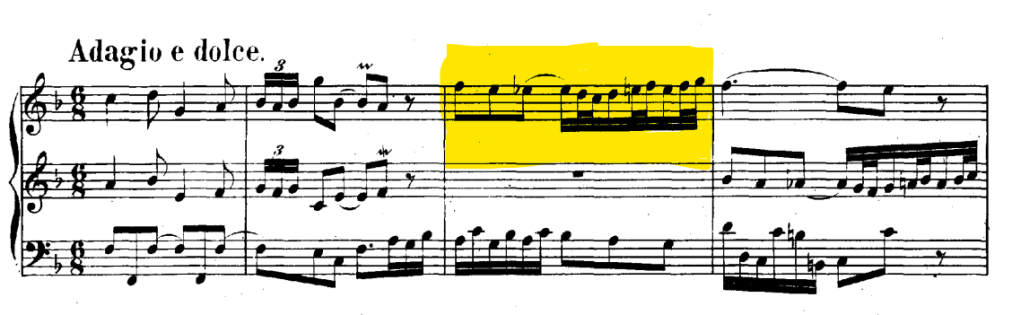
Bar 3 of Original BWV 527
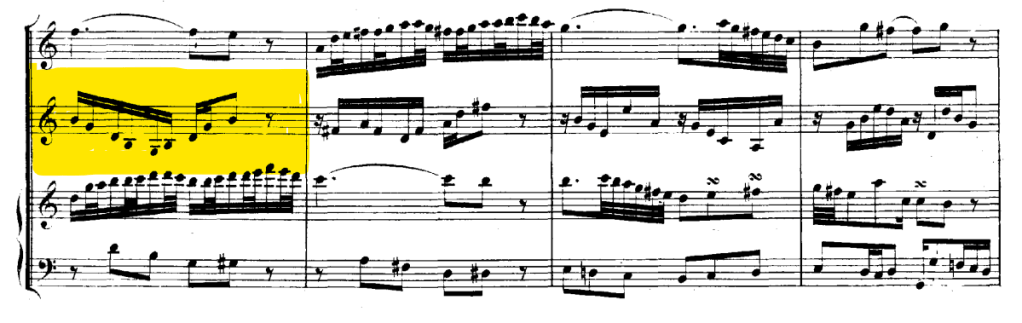
Bar 5 on the adapted BWV 1044
The scores illustrate Bar 3 voice 1 in the original and b5 in the adaptation. The Violin appears to comprise semiquavers in a retrograde and variation version. The notation can easily be associated with b 3 in voice one in the original. By doing so, Bach creates flow and coherence in the new voice.
The thematic material from the original appears to be passing from instrument to instrument. For instance, in the original, voice one is applied to the Harpsichord up to b8. From b9 up to b16, that is the repetition in the original The voice one is assigned to the Violin. This thematic assignation appears consistently with every repetition mark from the original. It is also worth highlighting the lack of repetition marks in the adapted version, perhaps due to the added material or to create a more appropriate score due to the concerto form. There is also another significant change in the adapted version regarding pitch. The pitch in the Harpsichord appears to be a fifth higher in the treble clef and a fourth lower in the bass clef.
One addition to the adapted score seems to be the extra embellishments. These are trills, appoggiatura, and acciaccatura. I feel the composer has chosen to increase the embellishment to enhance the listening experience and reinforce the stylistic characteristics of the late Baroque period. The piece is believed to be composed between 1927-1932, just before the emergence of Classical music. Therefore, additional embellishments were applied in the adaptation of BWV 527. Examples of additional embellishments can be found below.
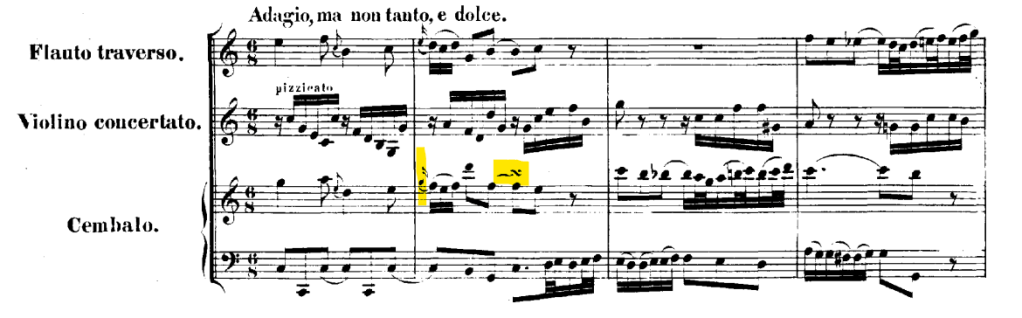
The appoggiatura, on the second bar’s first beat, is highlighted along with the turn—both additional embellishments of voice one in the original.
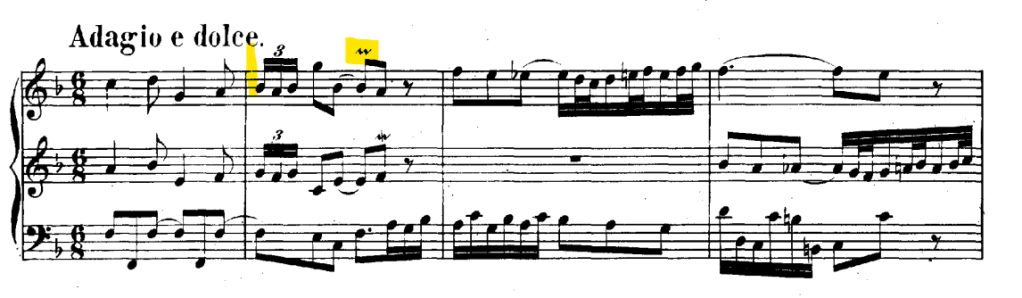
The score above illustrates the lack of the appoggiatura and the mordent. This decoration is later exchanged with a turn.
Also, it is believed that as music and styles evolve, the composer’s mind also changes. It could be suggested that other styles and composers of the time could have influenced Bach. Britannica encyclopaedia confirms the above statement by stating that Bach had been decisively influenced by the new styles and forms of the contemporary Italian opera and by the innovations of such Italian concerto composers as Antonio Vivaldi. Such a statement could also be a clue of the reason for the choice of instrumentation from the composer.
Overall, the character of the music in the adapted version is livelier than in the original. Although a versatile instrument, the organ appears dull, and the original version’s voices become muddy or unclear. That said, the calm and almost religious experience produced by the organ alone cannot be achieved in the adapted version. One can also question if we have a ‘pre-set’ mind to certain sounds, associating certain music or particular instruments to styles and experiences. Regarding the listening experience, I feel that variety of instrumentation produces a more intriguing timbral umbrella and, thus, a better listening experience. The voices appear brighter in the adapted version, and the lines are more transparent than in the original. One interesting point on the adapted version is perhaps the lack of articulations. Having a flute and a violin performing some articulations like staccatos or pizzicatos would have enhanced the listening experience adding variety to the timbral spectrum. However, is there any reason behind the lack of added articulation to the adapted composition? Could Bach mean to keep the voices as close as possible to the original? Also, the lack of dynamics is apparent in the adapted version. However, it is known that these directions, even tempo markings, were lacking or very rare at the time of Bach. Most directions were already more or less agreed upon for different types of compositions and left for the performer to decide (Taylor. 1989:75).
Reference:
Emery, Walter and Marshall, Robert L.. “Johann Sebastian Bach”. Encyclopedia Britannica, https://www.britannica.com/biography/Johann-Sebastian-Bach. Accessed 26 February 2023.
Netherlands Bach Society. BWV 527. Accessed 26 February 2023 from: https://www.bachvereniging.nl/en/bwv/bwv-527
Taylor, E. 1989. The AB Guide to Music Theory part 1. ABRSM
Next: Critical Review
 Orchestration and Arrangement